
Cracking Solana Staking: Native, Pools, and LSTs Unlocked – Insights from DuneCon 2024
By [Your Name] • March 4 2026
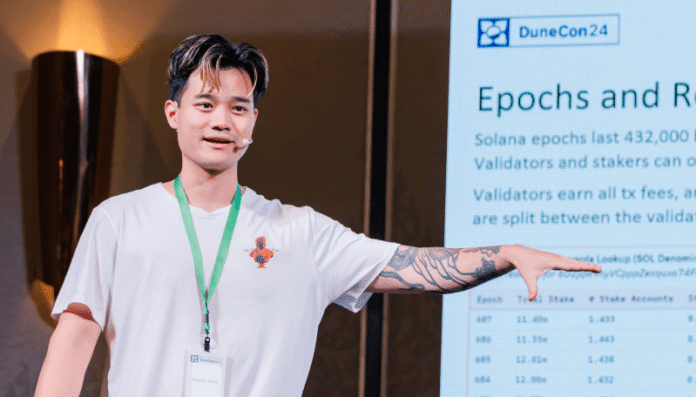
At this year’s DuneCon 2024, former Dune head of research Andrew Hong delivered a deep‑dive into the mechanics of Solana’s staking ecosystem. Hong, who spent several years building analytical tooling for the blockchain data firm, broke down the three primary pathways for securing the network—native delegation, staking pools, and liquid staking tokens (LSTs)—and examined how each model influences decentralization, validator incentives, and the broader DeFi landscape.
The Architecture Behind Solana’s Delegated Proof‑of‑Stake
Hong opened with a primer on Solana’s epoch‑based consensus. The network advances through 2‑day epochs, during which validators process transactions and generate proof‑of‑history (PoH) timestamps. Stakers allocate SOL to validator “vote accounts,” earning rewards proportional to the validator’s performance and the amount of stake delegated.
Key points about the native staking flow:
- Stake accounts are separate on‑chain entities that must be created, delegated, and eventually de‑activated. Their lifecycle differs from ordinary token transfers, making them invisible to standard transaction logs.
- Reward distribution occurs at epoch boundaries, and a validator’s commission is taken before rewards are forwarded to delegators.
- Data extraction is non‑trivial; the inner‑program instructions that modify stake accounts bypass the usual SPL token transfer events, requiring specialized parsers to capture the full picture.
These characteristics lay the groundwork for the more complex staking solutions that have emerged on Solana.
Staking Pools: Aggregating Power, Sharing Risk
The second segment focused on pooled staking services. By bundling SOL from many users into a single “pool account,” providers can allocate the collective stake across a diversified set of validators, potentially smoothing out performance variance and lowering the minimum entry barrier for retail participants.
Hong highlighted two dominant players:
| Pool Provider | Approx. Share of Staked SOL | Commission Model |
|---|---|---|
| Helus | ~20 % | 5 % of rewards |
| Coinbase | ~15 % | 8 % of rewards |
The concentration of stake among a handful of pools has reignited debates over true decentralization. While pools simplify participation and can improve validator uptime through active rebalancing, they also amplify the influence of a few custodial entities on network security and governance.
Liquid Staking Tokens: Bridging Staking and DeFi
Liquid staking tokens—such as mSOL, stSOL, and the newer single‑validator LSTs—represent a third, rapidly evolving layer. These assets are minted when a user deposits SOL into a staking contract; the contract then delegates the underlying SOL to validators while issuing an ERC‑20‑compatible token that can be traded, used as collateral, or incorporated into yield farms.
Hong contrasted Solana’s LST ecosystem with Ethereum’s more mature market:
- Adoption Gap – LSTs account for roughly 6 % of Solana’s total staked SOL, versus about 40 % on Ethereum.
- Creation Flexibility – Tools like the S‑Pool Factory enable developers to launch custom LSTs with bespoke validator selection and scoring algorithms, fostering experimentation but also fragmenting liquidity.
- Risk Profile – Single‑validator LSTs can offer higher yields but expose holders to validator‑specific downtime or slashing events, a risk less pronounced in diversified pool‑based LSTs.
The ability to move staked assets freely unlocks new DeFi primitives on Solana, from LST‑backed lending to composable yield aggregation strategies. Yet, the relatively low utilization suggests that many participants remain cautious about the added complexity and smart‑contract risk.
Analytical Challenges: Tracking Solana‑Specific Staking Activity
A recurring theme in Hong’s talk was the difficulty of accurately measuring staking dynamics on Solana. Because stake‑related state changes are executed via low‑level program instructions that do not emit standard SPL token transfer events, conventional blockchain analytics pipelines miss large portions of the activity.
Hong’s team at Dune built custom parsers to decode these inner‑program calls, enabling:
- Real‑time monitoring of stake activation/deactivation.
- Granular attribution of rewards to delegators versus validator commissions.
- Cross‑protocol insight into how LST issuance correlates with DeFi liquidity.
These tools are now being released as open‑source modules, offering the broader community a way to bridge the data gap.
Key Takeaways
- Concentration vs. Decentralization – Helus, Coinbase, and a few other large pools dominate Solana’s staking landscape, sparking ongoing discussion about the trade‑off between user convenience and network decentralization.
- Liquid Staking Still Niche – Despite its potential to fuel DeFi, LSTs represent a modest slice of total stake on Solana, lagging behind Ethereum’s adoption rates.
- Data Visibility Remains a Hurdle – The architecture of Solana’s stake accounts means that standard analytics tools cannot fully capture staking flows; specialized parsers are required to surface granular insights.
- Innovation Encouraged by Tooling – Platforms like the S‑Pool Factory lower the barrier for launching new LST products, fostering experimentation but also introducing fragmentation that could dilute liquidity.
- DeFi Integration Path Forward – As LSTs become more widely understood and integrated into lending, derivatives, and AMM protocols, they are poised to become a catalyst for deeper DeFi activity on Solana.
Outlook
Hong concluded the session by fielding questions on validator performance incentives, the future of single‑validator LSTs, and the potential regulatory implications of liquid staking. He projected that, over the next 12‑18 months, Solana’s staking ecosystem will see gradual diversification as newer LST issuers and community‑run pools gain traction, while analytic tooling will continue to mature, offering clearer visibility into staking health and DeFi integration.
For developers, investors, and analysts watching Solana’s evolution, the session underscored that understanding the nuances of native staking, pooled delegation, and liquid staking is essential to evaluating the network’s security outlook and its capacity to support next‑generation DeFi products.
Source: https://dune.com/blog/cracking-solana-staking-native-pools-and-lsts-unlocked










































