Did Layer‑2 Fragment Ethereum? – Insights from Yuval Rooz, Co‑founder & CEO of Canton Network
By [Your Name], 27 Feb 2026
TL;DR
- The rapid proliferation of Ethereum Layer‑2 (L2) solutions is delivering the scaling gains the ecosystem promised, but it is also generating a “sharding‑by‑protocol” effect that can fragment liquidity, developer effort, and user experience.
- Yuval Rooz, the co‑founder and CEO of Canton Network, argues that this fragmentation is not inevitable; it can be curbed through standardized data‑availability layers, cross‑rollup messaging, and shared security assumptions.
- Key takeaways: interoperability standards, unified SDKs, and a robust ecosystem of “bridges‑as‑services” will be crucial if Ethereum’s L2 landscape is to stay cohesive and fulfill the promise of a unified, scalable, and secure smart‑contract platform.
1. Why the Question Matters
Ethereum’s original roadmap placed Layer‑2 scaling at the heart of its growth strategy. Optimistic rollups, zk‑rollups, sidechains, and hybrid solutions have all emerged in the last few years, collectively lifting daily transaction throughput from a few dozen thousand to well over a million.
However, each rollup brings its own calldata format, proof system, and data‑availability (DA) assumptions. As the number of L2s expands, users and developers must decide where to deposit assets, which chains to build on, and how to move value across them. The resulting “L2 sprawl” raises a critical question for the Ethereum community: Are we building a single, unified scaling layer, or are we inadvertently fragmenting the network?
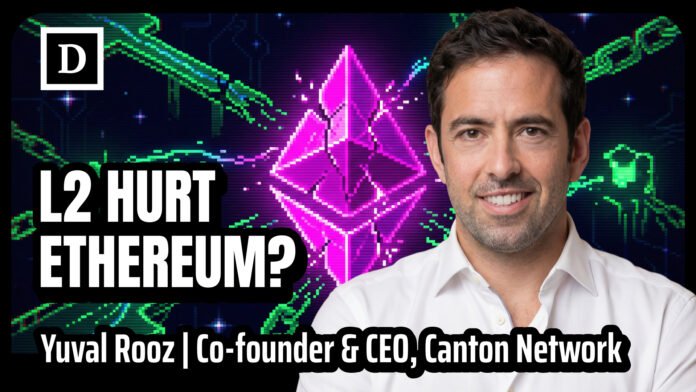
The Defiant’s recent episode “Did L2 Fragment Ethereum?” featured a conversation with Yuval Rooz, co‑founder and CEO of Canton Network, a startup focused on cross‑rollup data availability and messaging. Rooz’s perspective offers a nuanced view of both the risks and the mitigation pathways.
2. The State of L2 Fragmentation – Rooz’s Diagnosis
2.1. A Multi‑Rollup Ecosystem
Rooz notes that the Ethereum ecosystem now hosts dozens of active rollups, ranging from Optimism and Arbitrum (optimistic) to StarkNet, zkSync, and Loopring (zero‑knowledge). While each brings distinct trade‑offs—optimistic rollups favor simplicity and lower gas costs, zk‑rollups emphasize succinct proofs and instant finality—they also compete for the same liquidity pools.
“From a user’s standpoint, it feels like choosing between a dozen different banks, each with its own onboarding process, currency, and fee schedule,” Rooz paraphrased. “That friction is the first symptom of fragmentation.”
2.2. Data‑Availability Divergence
Beyond settlement, a more technical source of fragmentation lies in data‑availability (DA) layers. Optimistic rollups rely on Ethereum’s native DA, while many zk‑rollups are experimenting with external DA solutions (e.g., Celestia, Avail). This divergence creates incompatible assumptions about how data can be retrieved and verified, complicating cross‑rollup proofs and increasing the risk of “data islands” that cannot be easily shared.
2.3. Composability Gaps
Ethereum’s core value proposition—composability—relies on universal contract addresses and atomic interactions. Rooz points out that when a DeFi application spans multiple rollups, atomicity is lost unless a bridging layer can guarantee that state changes on one L2 are reflected exactly on another. Existing bridges often operate as “trust‑but‑verify” hubs, adding latency and counter‑party risk.
“We’re seeing a de‑facto ‘Layer‑2 silos’ phenomenon,” Rooz said. “If a trader wants to arbitrage between Curve on Arbitrum and Uniswap on zkSync, they must move funds through a bridge that may be slow, costly, or even unsafe.”
3. Canton Network’s Approach to Reducing Fragmentation
Canton positions itself as a cross‑rollup data‑availability and messaging layer that can act as a neutral “Internet” for L2s. Its roadmap focuses on three pillars:
| Pillar | Description | Expected Impact |
|---|---|---|
| Unified DA Interface | An abstraction layer that lets rollups plug into any DA provider (Ethereum, Celestia, Avail) through a standard API. | Reduces DA heterogeneity, allowing rollups to interoperate without rewiring their consensus mechanisms. |
| Cross‑Rollup Messaging (XRM) | Cryptographically verifiable messages that travel between rollups without the need for a centralized bridge. | Enables atomic cross‑rollup transactions and composable DeFi primitives (e.g., multi‑chain liquidity pools). |
| Security‑as‑a‑Service | Optional shared fraud‑proof or validity‑proof infrastructure that rollups can opt into, lowering the security‑budget for smaller chains. | Aligns security assumptions across rollups, preventing a “weak‑link” scenario where one L2’s compromise jeopardizes the whole ecosystem. |
Rooz emphasizes that Canton does not aim to replace existing bridges but to complement them with a service‑oriented architecture that can be adopted incrementally. “Think of it as an open‑source postal system for L2s,” he analogized, “where every rollup can drop a package in the same mailbox and trust that it will be delivered safely.”
4. Analyst Takeaways
-
Fragmentation is Real, But Not Terminal – The proliferation of rollups has introduced friction points in user onboarding, liquidity concentration, and composability. However, these are engineering challenges rather than fundamental flaws.
-
Standardization Is the Critical Lever – Interoperability standards for DA, cross‑rollup messaging, and bridge interfaces can dramatically reduce the “silo” effect. Industry initiatives such as EIP‑4844 (proto‑Dencun), EIP‑7702 (rollup‑agnostic calldata), and emerging Cross‑Rollup Messaging (XRM) drafts are already moving the needle.
-
Infrastructure Providers Will Shape the Future – Projects like Canton, Celestia, Avail, and the upcoming Ethereum Data Availability Layer (EDAL) have the potential to become the “common road” that connects disparate L2s. Their success will hinge on wide adoption and proven security guarantees.
-
Liquidity Incentives Remain a Must‑Have – Even with perfect technical interoperability, market participants need economic incentives to move capital across L2s. Expect to see more cross‑rollup yield farming, multi‑chain vaults, and meta‑protocols that reward users for bridging assets.
- Regulatory Lens May Intensify – Fragmented L2s could attract disparate regulatory scrutiny, especially if bridges become points of failure. Unified infrastructure layers could aid compliance by providing transparent audit trails for cross‑chain flows.
5. What’s Next for Ethereum’s L2 Landscape?
-
Short‑Term (0‑12 months): Expect a wave of bridge‑as‑a‑service offerings that embed XRM protocols, lowering the cost of cross‑rollup swaps. Canton’s testnet is slated to launch a beta DA‑API that supports both Ethereum and Celestia, providing a tangible proof point.
-
Mid‑Term (1‑2 years): As ETH 2.0 upgrades (e.g., full sharding) roll out, the distinction between L1 and L2 may blur. Rollups could become “sub‑shards” that share the same DA, making fragmentation less pronounced.
- Long‑Term (3‑5 years): A universal data‑availability market could emerge, where any rollup can purchase DA bandwidth on a spot market, similar to cloud storage. This would effectively decouple scaling from DA, allowing interoperability to be driven purely by economic incentives.
6. Key Takeaways
| Takeaway | Implication |
|---|---|
| Fragmentation exists – Multiple L2s create user and developer friction. | Prompt need for interoperability solutions. |
| Standardization is essential – Unified DA APIs and messaging protocols can reconnect silos. | Projects like Canton are positioned to become critical infrastructure. |
| Economic incentives will drive adoption – Cross‑rollup yield and liquidity rewards are necessary to align market forces. | Expect growth in meta‑protocols that operate across L2s. |
| Security alignment matters – Shared fraud‑proof or validity‑proof services can raise the overall security floor. | Reduces the risk of a single weak L2 compromising the ecosystem. |
| Regulatory clarity will favor cohesive systems – Transparent cross‑chain audit trails are a compliance advantage. | Unified infrastructure could simplify regulatory reporting. |
Conclusion
Layer‑2 solutions have undeniably delivered the scaling Ethereum needed to sustain its burgeoning DeFi, NFT, and Web3 ecosystems. Yet, as Yuval Rooz reminds us, the rapid, uncoordinated expansion of rollups risks fragmenting the very network they aim to amplify. By converging on common data‑availability standards, cross‑rollup messaging, and shared security services, the ecosystem can preserve Ethereum’s core promise of open, composable finance while still reaping the performance gains of L2 scaling.
For readers interested in a deeper dive, the full episode of “Did L2 Fragment Ethereum?” is available on The Defiant’s podcast platform, featuring an extended interview with Yuval Rooz.
Source: https://thedefiant.io/podcasts-and-videos/podcast/didl2-fragment-ethereum-with-yuval-rooz-co-founder-and-ceo-of-canton-network