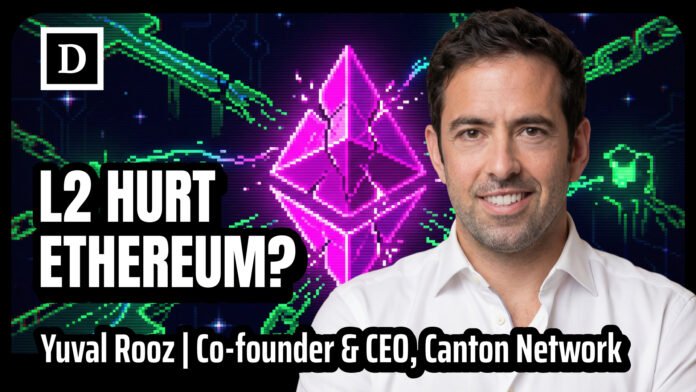
Did Layer‑2s Fragment Ethereum? An Interview with Yuval Rooz, CEO of Digital Asset and Co‑Founder of Canton
By [Your Name] – February 27 2026
Ethereum’s long‑standing promise of “roll‑up” scaling has now become a reality: dozens of Layer‑2 (L2) solutions—optimistic rollups, zk‑rollups, sidechains and Validium‑type constructions—process the bulk of daily transactions. Yet as the ecosystem matures, a new question emerges. Rather than unifying the network, are the proliferating L2s unintentionally fragmenting Ethereum’s user base, liquidity, and security guarantees?
Yuval Rooz, chief executive officer of Digital Asset and co‑founder of the Canton interoperability platform, explored this topic in a recent conversation hosted by The Defiant. Drawing on his experience building the first enterprise‑grade blockchain infrastructure and spearheading cross‑rollup initiatives, Rooz offered a nuanced view of the trade‑offs that accompany L2 diversification.
The Scaling Landscape in 2026
Since the Merge, Ethereum’s base layer has stayed relatively stable, with a modest 3‑5 % annual gas price increase. However, demand for high‑throughput DeFi, gaming, and NFT experiences still outpaces L1 capacity. L2 solutions now carry roughly 70 % of the total transaction volume across the Ethereum ecosystem, according to on‑chain analytics firm Dune. The dominant rollups—Arbitrum, Optimism, zkSync, and StarkNet—each host distinct developer communities and liquidity pools.
Rooz notes that “the market has moved from ‘one‑or‑two rollups’ to a vibrant, competitive set of solutions, each optimized for a particular use case.” While competition drives innovation, it also creates a silo effect: users must choose a rollup to interact with a given dApp, assets become locked in specific data‑availability layers, and bridge usage spikes.
Fragmentation: Symptoms and Drivers
Rooz identified three primary dimensions where fragmentation manifests:
| Dimension | Symptoms | Underlying Drivers |
|---|---|---|
| User Experience | Wallets need rollup‑specific addresses; transaction confirmations vary; users must manually bridge assets. | Lack of a unified address namespace and disparate fee models. |
| Liquidity | Separate order books on each rollup; fragmented AMM pools; reduced depth for cross‑rollup trades. | No native, trust‑less cross‑rollup market‑making infrastructure. |
| Security Guarantees | Divergent data‑availability (DA) guarantees (e.g., DA‑on‑chain vs. external) lead to uneven risk profiles. | Different rollup designs (optimistic vs. zk) require separate fraud‑proof or verification mechanisms. |
“The core of Ethereum’s value proposition—global, permissionless, secure consensus—remains intact,” Rooz emphasized, “but the user journey now resembles a labyrinth of bridges, each with its own risk calculus.”
The growth of bridges underscores this trend. Dune reports a 15‑fold increase in bridge transactions year‑over‑year, with total value locked (TVL) across bridges surpassing $45 billion. While bridges enable movement of assets, they also concentrate risk: the Wormhole and Polygon bridge hacks of 2023 and 2024 respectively resulted in cumulative losses exceeding $3 billion, reinforcing concerns about “bridge‑centric fragmentation.”
Interoperability as a Remedy
Digital Asset’s Canton platform, launched in 2024, aims to address exactly these challenges. Canton provides a permissioned, off‑chain messaging layer that allows rollups to share state proofs without relying on a centralized bridge. In the interview, Rooz described Canton as “a universal lingua franca for rollups—a place where you can broadcast a transaction receipt from zkSync and have it verified instantly on Optimism.”
Key technical features of Canton include:
- Standardized State‑Commit Proofs – Rollups publish succinct Merkle proofs that Canton validates against a shared on‑chain registry.
- Atomic Cross‑Rollup Swaps – By leveraging a two‑phase commit protocol, Canton enables trades that settle simultaneously across multiple L2s, eliminating the need for intermediate bridges.
- Unified Asset Registry – Tokens minted on any rollup can be referenced by a global identifier, allowing wallets to display a single balance view.
Rooz cautioned that “interoperability is not a silver bullet.” The success of any cross‑rollup solution depends on adoption by the rollup operators and alignment on security assumptions. For instance, a rollup that outsources data availability to an external DA service must ensure that its proofs remain valid even if the DA provider fails.
Market Signals and Outlook
The market appears to be responding. In Q4 2025, Optimism announced a direct channel with Arbitrum that leverages Canton’s messaging layer, enabling “instant, trust‑less token swaps” for a subset of LPs. Early data suggests a 12 % reduction in average bridging latency and a 5 % increase in cross‑rollup arbitrage volume.
Meanwhile, Ethereum’s core developers have begun formalizing “rollup‑agnostic standards.” The upcoming EIP‑4834 proposes a universal rollup address format and a set of on‑chain events that wallets can listen to, simplifying multi‑rollup UI flows.
Still, fragmentation is not purely technical. Economic incentives keep users tethered to a particular rollup: lower fees, faster finality, or exclusive access to certain dApps. Rooz argues that “as long as the value proposition of a rollup is unique and compelling, we will see pockets of specialization—a healthy ecosystem, not a broken one.”
Key Takeaways
| Takeaway | Implications |
|---|---|
| L2s have outpaced L1 in transaction volume, but at the cost of user‑experience complexity. | Wallets and UI layers must integrate multi‑rollup support to stay user‑friendly. |
| Liquidity fragmentation reduces market efficiency and inflates slippage for cross‑rollup trades. | Solutions like Canton’s atomic swaps could restore depth and price discovery. |
| Security heterogeneity introduces varying risk profiles across rollups. | Users and institutions need clearer risk‑disclosure frameworks for each DA model. |
| Interoperability standards are emerging (EIP‑4834, Canton), indicating industry consensus on the need for cohesion. | Early adopters may gain a competitive edge by offering seamless cross‑rollup experiences. |
| Economic differentiation will persist; fragmentation is not inherently negative if managed with robust bridges and shared standards. | A balanced ecosystem where specialized rollups coexist with interoperability will likely be the long‑term equilibrium. |
Looking Ahead
Rooz concluded on an optimistic note: “Ethereum’s strength has always been its ability to evolve through open collaboration. Layer‑2s are the latest chapter of that story. If we channel the innovation across rollups into shared protocols—rather than isolated silos—we’ll preserve Ethereum’s universality while delivering the scalability users demand.”
The conversation underscores a pivotal moment for the Ethereum ecosystem. As L2s continue to proliferate, the industry’s ability to harmonize rather than fragment will determine whether Ethereum can truly become the “world computer” envisioned a decade ago. Stakeholders—from developers and wallets to institutional investors—should watch the evolution of interoperability frameworks closely; they may well define the next wave of DeFi growth.
Source: https://thedefiant.io/podcasts-and-videos/podcast/did-l2-fragment-ethereum-with-yuval-rooz-ceo-of-digital-asset-co-founder-of-canton