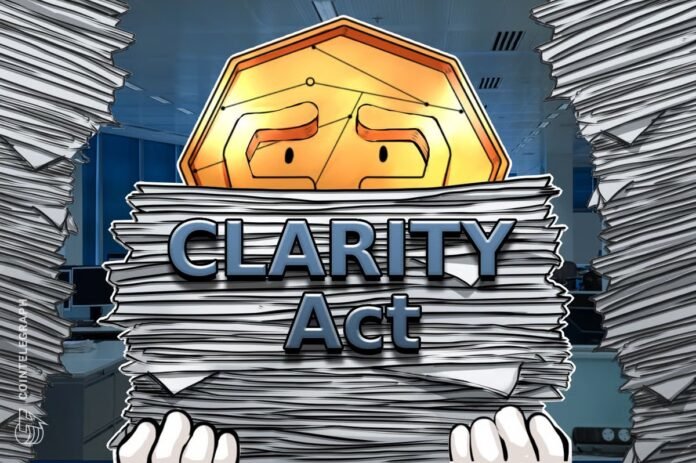
US CLARITY Act Could Clear Congress by April, Senator Moreno Says
Washington, D.C. – February 19, 2026 – The legislative package known as the CLARITY Act – a bill intended to bring greater regulatory certainty to the United States cryptocurrency market – may clear the Capitol within the next month, according to Senator Bernie Moreno (R‑FL). In a televised interview with CNBC from President Donald Trump’s Mar‑a‑Lago resort on Wednesday, Moreno told the network that he hopes the measure will be enacted “by April.”
The discussion, which also featured Coinbase chief executive Brian Armstrong, took place at the World Liberty Financial (WLF) Crypto Forum. The forum gathered representatives from the crypto sector, traditional banking, and members of Congress to examine a possible “path forward” on market‑structure reforms.
What’s at Stake
The CLARITY Act seeks to:
- Designate the U.S. Securities and Exchange Commission (SEC) as the primary regulator of digital assets.
- Prohibit interest‑bearing stablecoins—tokens that promise a yield tied to a fiat currency.
- Provide a framework for how crypto firms may interact with U.S. banks and custodians.
The bill’s stablecoin‑reward provisions have been a flashpoint. Banking industry groups argue that offering yields on stablecoins could siphon deposits from traditional banks, while crypto firms contend that stablecoins are essential for liquidity and on‑ramp services. Armstrong noted that his company withdrew support for the draft legislation in January after the ban on interest‑bearing stablecoins and the exclusive SEC oversight were added. He now believes the latest negotiations have produced a “win‑win‑win” scenario for the crypto industry, banks, and American consumers, aligning with the administration’s goal of positioning the United States as a global crypto hub.
Political Landscape
Moreno dismissed concerns that a Democratic surge in the 2026 midterms could derail the bill, stating that both chambers of Congress are expected to remain under Republican control. He linked the legislation to broader voter frustrations with “open borders, high inflation, and an out‑of‑control government,” framing the CLARITY Act as a response to those sentiments.
White House officials have echoed optimism. On Dec. 19, the administration’s crypto and AI adviser, David Sacks, said the Senate was poised to move the legislation forward in January, emphasizing that the effort is “closer than ever.” Sacks’ comments, however, predate the recent setbacks over stablecoin rewards and the Coinbase pull‑back.
Market Sentiment
Prediction market Polymarket briefly pushed the odds of the CLARITY Act becoming law in 2026 to 90 % after the Wednesday interview, before settling at around 72 % by the time of publication. The fluctuation reflects both the renewed confidence among some market participants and lingering uncertainty over the bill’s final language.
Analysis
- Regulatory Clarity vs. Innovation: By centralizing authority with the SEC and restricting yield‑bearing stablecoins, the bill could reduce regulatory arbitrage but may also limit product innovation that has driven much of the sector’s growth.
- Bank‑Crypto Relations: Removing the stablecoin‑reward element could ease banks’ concerns about deposit flight, potentially unlocking new partnerships and custody services for crypto firms.
- Political Viability: Moreno’s confidence hinges on the assumption that the GOP retains control of Congress. A shift in the House or Senate could re‑introduce amendments or stall the bill entirely.
- Industry Positioning: Coinbase’s shift from opposition to conditional support underscores the pragmatic stance many exchanges are taking—prioritizing a workable regulatory framework over ideal policy outcomes.
Key Takeaways
| Point | Implication |
|---|---|
| Target passage by April | If accurate, the CLARITY Act would become the first comprehensive crypto‑market‑structure law enacted under the Trump administration. |
| Stablecoin reward ban | Removes a major source of banking opposition, but may curb certain DeFi use cases that rely on yield‑bearing stablecoins. |
| SEC as lead regulator | Consolidates oversight, potentially simplifying compliance but also increasing the SEC’s workload and influence over the sector. |
| Political headroom | The bill’s trajectory assumes continued Republican majorities; any change could introduce new legislative hurdles. |
| Industry reaction | Coinbase’s tentative endorsement signals broader market willingness to adapt if the final bill balances regulatory certainty with limited restrictions. |
The coming weeks will reveal whether the CLARITY Act can surmount its remaining obstacles or if further compromises will be required. Stakeholders across the crypto ecosystem, from exchanges to banks and regulators, are watching closely as the legislative clock ticks toward the April deadline.
Source: https://cointelegraph.com/news/crypto-us-clarity-act-coinbase-brian-armstrong-bernie-moreno?utm_source=rss_feed&utm_medium=feed&utm_campaign=rss_partner_inbound