
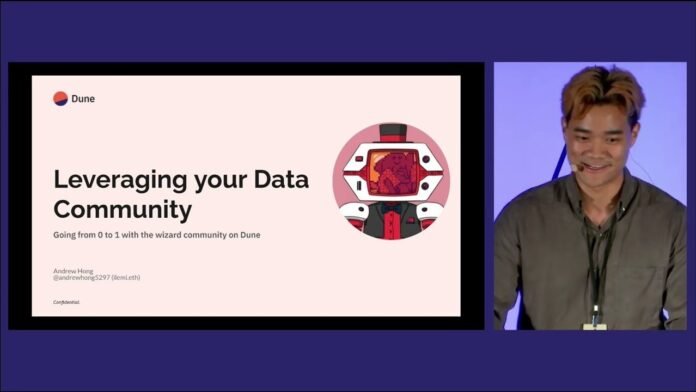
Leveraging Data Communities in Web3: Insights from Andrew Hong’s Recent Talk
By [Author Name] – March 4, 2026
In a recent presentation that has quickly garnered attention among developers and analysts alike, blockchain veteran Andrew Hong delved into the evolving landscape of the Web3 data economy. The session, titled “Leveraging Your Data Communities,” offered a comprehensive overview of the ecosystem’s key participants and outlined practical guidance for Solidity developers seeking to make their on‑chain data more accessible to analytical tools.
The Data Economy Landscape
Hong framed the Web3 data economy as a multi‑layered network where on‑chain activity, off‑chain indexing services, and community‑driven data repositories intersect. According to his assessment, three primary actors shape this environment:
- Protocol Engineers – architects of smart contracts who determine the structure and granularity of emitted events.
- Indexing Platforms – services such as The Graph, Dune Analytics, and emerging decentralized indexing nodes that parse and organize on‑chain data.
- Data Consumers – analysts, traders, and application developers who rely on clean, timely data to inform decisions and build user‑facing products.
By highlighting how each group contributes to the flow of information, Hong underscored the importance of aligning development practices with the needs of downstream users. “When engineers think beyond the immediate transaction and consider the downstream analytical pipeline, the entire ecosystem benefits,” he noted during the talk.
Advice for Solidity Developers
One of the session’s most actionable segments focused on best practices for Solidity developers aiming to enhance data usability. Hong emphasized three core strategies:
-
Consistent Event Naming: Using predictable and descriptive event names reduces the cognitive load on indexers and analysts. He recommended adhering to a naming convention that mirrors the function’s purpose, e.g.,
Transfer,Deposit,Withdrawal. -
Comprehensive Parameterization: Emitting all relevant state variables in events—rather than relying on secondary calls—streamlines the extraction process. Hong cited examples where omitting critical fields forced analysts to reconstruct state from multiple contract calls, increasing latency and error probability.
- Schema Documentation: Publishing a clear schema for each event, preferably in a machine‑readable format such as JSON‑Schema, enables indexing services to automatically generate parsers. This practice also facilitates community contributions to data validation and enrichment.
By adopting these guidelines, developers can lower the barrier for analysts to integrate on‑chain data into dashboards, predictive models, and trading strategies.
Community‑Driven Data Initiatives
Hong also highlighted the rise of “data communities”—collectives of developers, analysts, and enthusiasts who collaboratively maintain and curate data sets. These groups often operate on decentralized platforms, leveraging token incentives and governance mechanisms to ensure data integrity. Notable examples include:
-
Open Data DAO: A DAO that funds the curation of high‑quality datasets for DeFi protocols, rewarding contributors with governance tokens.
- Cross‑Chain Indexing Alliances: Partnerships between indexing services aiming to provide unified views across multiple L1 and L2 networks.
Such collaborations, Hong argued, are pivotal for scaling the data economy as the number of active protocols continues to expand.
Key Takeaways
| Takeaway | Implication |
|---|---|
| Event design matters | Well‑structured events reduce indexing complexity and accelerate analyst workflows. |
| Documentation is a competitive advantage | Clear schemas and naming conventions position a protocol as “analytics‑ready,” attracting more third‑party integrations. |
| Data communities add resilience | Decentralized curation mitigates single points of failure and improves data quality over time. |
| Token incentives can align interests | Reward mechanisms for data contributors foster sustainable ecosystem growth. |
Looking Ahead
As the Web3 data economy matures, the synergy between developers and analysts will become increasingly critical. Hong’s recommendations point toward a future where smart contract design is inherently data‑centric, enabling richer analytics and more sophisticated financial products.
For those interested in following Andrew Hong’s commentary and upcoming projects, he is active on Twitter: @andrewhong5297.
Disclaimer: This article is for informational purposes only and does not constitute investment advice.
Source: https://dune.com/blog/leveraging-your-data-communities-with-andrew-hong










































