Dune Index Offers a Unified Lens on Real‑World Blockchain Adoption
By [Your Name] – March 3 2026
The blockchain analytics community has long wrestled with how to measure genuine network usage. Traditional gauges such as price, total value locked (TVL) or raw transaction counts often paint an incomplete picture, obscuring the underlying economic activity that truly drives adoption.
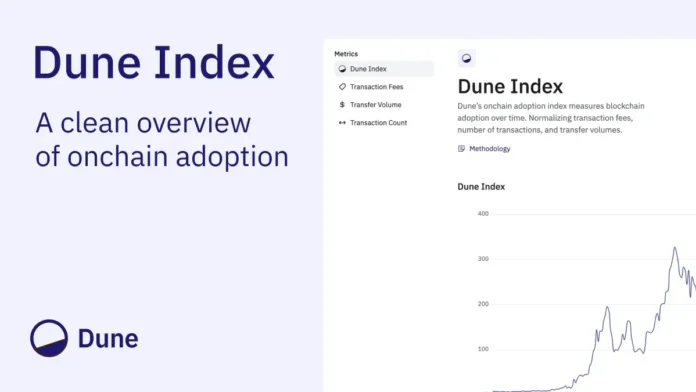
Enter the Dune Index – a composite metric that aggregates core on‑chain signals into a single, cross‑chain score. Launched by the analytics platform Dune, the index is designed to filter out noise and provide investors, developers, and policymakers with a clearer view of how blockchain ecosystems are being used in practice.
Why a New Metric Is Needed
Most existing dashboards rely on isolated figures—price spikes, TVL, number of active addresses, or sheer transaction volume. While each offers a glimpse of activity, none captures the whole story:
- Price can be detached from usage, often reflecting speculation more than network health.
- TVL aggregates assets locked in smart contracts but ignores how often those assets move.
- Address counts and gross transaction volume are prone to inflation from bot activity, internal transfers, or “change” outputs on UTXO‑based chains.
These shortcomings have prompted analysts to stitch together disparate datasets, a process that is both time‑consuming and prone to misinterpretation. The Dune Index addresses this gap by consolidating three fundamental pillars—fees, net transfers, and meaningful transactions—into a normalized score that can be tracked over time and compared across blockchains.
How the Index Is Constructed
| Component | Weight in Index | Methodology Highlights |
|---|---|---|
| Fees | 45 % | Captures the economic cost of using a network. Data are sourced from Dune’s gas‑fees catalog and reflect the real monetary effort required to execute on‑chain actions. |
| Net Transfers | 45 % | Rather than counting every output, the index calculates the net value moved between distinct parties, stripping out intra‑transaction “change” and duplicate movements. Special handling is applied for Solana (daily net aggregation) and UTXO‑based chains (change detection). |
| Transactions | 10 % | Only transactions that transfer at least $1 are counted, reducing the impact of dust or spam. Weighting is lower because transaction counts vary widely by chain architecture (e.g., multiple Solana transactions may correspond to a single Ethereum transaction). |
Address clustering is performed through Dune’s “Owner Labels” data, grouping known corporate wallets while keeping individual addresses separate. This approach provides a more realistic view of unique economic actors on each network.
Key Findings From Recent Data
-
Adoption Peaks Match Recent Bull Markets
The index recorded a weekly average of 88 in mid‑November 2024—on par with the 87 score seen during the 2021 rally and the 81 level recorded in May 2021. This suggests that the current market surge is accompanied by a genuine rise in on‑chain activity, not merely price speculation. -
Pricing Contextualised by Usage
- Solana (SOL): Despite price parity with its 2021 highs, Solana’s adoption metrics have surged, indicating that the current valuation is underpinned by increased real‑world usage.
- Bitcoin (BTC): Conversely, Bitcoin’s price sits well above previous peaks while its adoption score remains comparable to prior highs, hinting that the market presently values Bitcoin more as a store of value than a medium of exchange.
-
Cross‑Chain Landscape
The index highlights a clear hierarchy among blockchains:- Top tier – Solana, Tron, Ethereum, Bitcoin.
- Mid tier – BNB Chain, Base, Polygon, Arbitrum (each contributing roughly 1–5 % of the total index).
- Emerging – OP Mainnet, Avalanche‑c, Ronin, Mantle, which are exhibiting upward momentum.
- Growth of Emerging Networks
Ronin’s ascent, for instance, has been singled out by ecosystem leaders as a transparent illustration of how the Dune Index can showcase the rise of newer chains without ambiguities.
Analyst Perspective
The Dune Index’s holistic design offers a “single‑source truth” for measuring blockchain health. By normalising fees, net transfers, and filtered transactions, it mitigates the distortions that plague isolated metrics. For investors, the index can act as a sanity check: if price rallies are not mirrored by a rise in the score, the upside may be speculative. For developers and ecosystem builders, the breakdown reveals which layers—fees, transfer volume, or transaction count—are driving growth, informing strategic decisions around scaling and fee structures.
Takeaways
- A more reliable adoption gauge: The Dune Index supplies a nuanced, cross‑chain benchmark that outperforms traditional price‑or‑TVL‑centric views.
- Bull‑run validation: Recent high scores confirm that the latest market rally coincides with heightened on‑chain activity.
- Differentiated asset narratives: Solana’s surge in usage versus Bitcoin’s price‑driven ascent underscore the importance of contextualising valuations with adoption data.
- Emerging chain monitoring: The index makes it easier to spot rising ecosystems (e.g., Ronin, Mantle) as they climb in relative contribution to overall adoption.
- Strategic decision‑making: By dissecting the three components, stakeholders can pinpoint whether fee economics, transfer volume, or transaction breadth are the primary growth drivers.
Looking Ahead
As the blockchain landscape continues to fragment—new Layer‑1s, Layer‑2s, and specialized networks launching at a rapid pace—the need for a unified, verifiable adoption metric will only intensify. The Dune Index’s methodology, grounded in on‑chain data and transparent weighting, positions it as a pivotal tool for navigating the next wave of decentralized innovation.
Source: https://dune.com/blog/dune-index