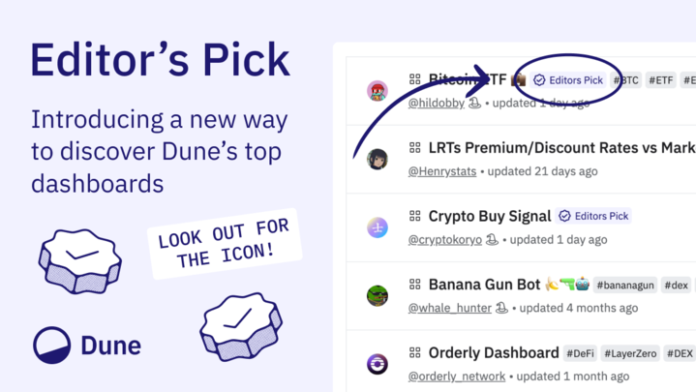
Dune Launches “Editor’s Pick” Badge to Highlight Top Crypto Dashboards
The analytics platform introduces a curated badge for high‑quality dashboards, offering greater visibility to creators and a clearer discovery experience for users.
San Francisco, March 4 2026 – Dune, the leading on‑chain analytics service, announced the rollout of an “Editor’s Pick” badge that will surface standout dashboards across its discovery and search interfaces. The initial wave of the program will feature 100 hand‑selected dashboards, each meeting a stringent set of quality standards set by the Dune editorial team.
“We want to recognise the wizards who consistently deliver deep, accurate, and well‑presented insights,” said a Dune spokesperson. “The badge not only rewards their effort but also makes it easier for the community to find reliable data sources.”
How the badge works
Dashboards that earn the badge are placed prominently at the top of Dune’s dashboard marketplace and appear first in search results. The badge is not permanent; creators must keep their visualisations accurate and current, or risk losing the distinction.
Qualification criteria
The editorial team outlined three core pillars that a dashboard must satisfy:
| Criterion | What the editors look for |
|---|---|
| Depth and breadth | A solid mix of charts, tables, and metrics that covers a topic (e.g., a protocol, token, or airdrop) from multiple angles. Examples include volume trends paired with market‑segment breakdowns, user‑persona analyses, and growth or retention curves. |
| Clarity of presentation | Visual elements must be neatly formatted—proper axis titles, consistent number formatting, and clear column headings. Supplementary text explaining methodology, linking to external resources, and providing context is also essential. |
| Timeliness | Given the rapid pace of the crypto ecosystem, dashboards should be refreshed at least semi‑annually. Ongoing engagement with project communities—through forums, Twitter, Telegram, etc.—is encouraged to ensure data stays relevant. |
Dashboards that repeatedly display inaccurate or misleading charts, or that fall behind on updates, will have the badge removed.
Getting considered
Creators are invited to submit their work by publishing the dashboard publicly and tagging @duneanalytics on either Twitter or LinkedIn. The platform highlighted a recent example where a user shared a dashboard with a concise story and clear use‑case, earning rapid editorial attention.
The referenced tweet can be found here: https://x.com/marcov_91/status/1785633298711994549.
Analyst perspective
The badge program signals a shift toward more curated content in a space traditionally dominated by user‑generated, unvetted analytics. By surfacing vetted dashboards, Dune aims to:
- Reduce information overload – Users can quickly locate dashboards that have passed a quality audit, cutting through the noise of hundreds of similarly titled projects.
- Boost creator incentives – Recognition can translate into greater traffic, community following, and potentially monetisation for dashboard authors.
- Raise industry standards – As more analysts strive to meet the badge criteria, overall data hygiene and methodological transparency are likely to improve.
However, the system also introduces a gatekeeping element. Smaller contributors without a large social media following may find it harder to get their work noticed, especially if the submission process relies heavily on tagging the brand on public platforms.
Key takeaways
- New “Editor’s Pick” badge will highlight 100 elite dashboards on Dune, giving them prime placement in discovery and search.
- Three‑point quality framework (comprehensiveness, visual clarity, and up‑to‑date data) defines eligibility; the badge can be rescinded for outdated or inaccurate content.
- Submission is social‑media driven – creators must publicly share their dashboards and tag @duneanalytics to be considered.
- Potential impact – The initiative could improve data reliability for DeFi researchers while rewarding high‑quality contributors, though it may also create visibility barriers for newcomers.
- Future outlook – Dune plans to expand the program beyond the inaugural 100 dashboards, continually refining its curation standards.
As Dune’s ecosystem matures, the “Editor’s Pick” badge may become a de‑facto benchmark for trustworthy on‑chain analytics, signaling to investors, developers, and journalists which dashboards merit a closer look.
Source: https://dune.com/blog/editors-pick-on-dune