Using Dune to Decode Crypto Market Dynamics – Insights from Richard Chen of 1confirmation
By [Your Name] – March 4 2026
In a recent conversation with the DeFi community, Richard Chen, General Partner at the venture firm 1confirmation (Twitter: @rchen8), laid out his approach to mining actionable intelligence from blockchain data using Dune Analytics. Chen, who has been an active voice in the web3 investment space for several years, emphasized how granular, on‑chain metrics can illuminate market sentiment, capital flows, and emerging trends that traditional financial data often miss.
Why Dune Matters for Market Analysis
Dune Analytics, the open‑source platform that allows users to query and visualize blockchain data, has become a staple in the toolkits of researchers, traders, and venture capitalists alike. According to Chen, its value lies in three core capabilities:
- Granular Transparency – By accessing raw transaction data across multiple chains, analysts can trace the exact pathways of funds, from large‑scale institutional wallets to retail addresses.
- Customizable Queries – Dune’s SQL‑based interface empowers users to build bespoke dashboards that surface niche metrics, such as token‑specific gas usage, liquidity provider (LP) churn, or cross‑chain bridge activity.
- Community‑Driven Knowledge – The platform’s public dashboards serve as a living repository of crowd‑sourced research, enabling rapid iteration and verification of hypotheses.
Chen highlighted that these features collectively reduce the “information asymmetry” that often plagues crypto markets, where early movers can capitalize on data that remains hidden from the broader public.
Chen’s Methodology: From Data to Decision
During the interview, Chen broke down his analytical workflow into four distinct stages:
| Stage | Description | Example Metric |
|---|---|---|
| Data Acquisition | Pull raw on‑chain events via Dune’s API, focusing on high‑impact contracts (e.g., major DEXes, Layer‑2 bridges). | Daily transaction count on Uniswap V3 pools. |
| Signal Extraction | Apply statistical filters to isolate meaningful patterns, discarding noise caused by spam or test transactions. | Volume‑weighted average price (VWAP) adjustments for flash‑loan spikes. |
| Contextual Overlay | Combine on‑chain signals with off‑chain data such as macroeconomic indicators, social sentiment, and funding round announcements. | Correlating DeFi TVL growth with Bitcoin’s price momentum. |
| Strategic Application | Translate insights into investment theses, risk assessments, or product roadmaps. | Identifying a surge in LP withdrawals as a leading indicator of market downturns. |
One practical illustration Chen offered involved monitoring “whale” movements on Ethereum. By tracking the net inflow/outflow of the top 0.1% of token holders across a rolling 7‑day window, his team could gauge the risk appetite of large investors. A sustained net outflow, he noted, often preceded a broader correction in the sector.
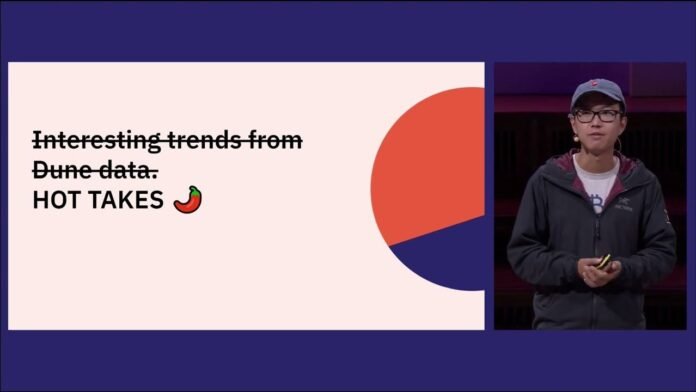
Hot Takes on the Current Market Landscape
When pressed for his perspective on where the crypto market stands today, Chen delivered several points that resonated with the broader DeFi audience:
-
Liquidity Migration to Layer‑2s: Chen observed a “steady reallocation of capital” from Ethereum’s L1 to Layer‑2 solutions such as Arbitrum and Optimism. Using Dune dashboards that track bridge deposits, he noted a 32% YoY increase in L2 TVL, suggesting that users are seeking lower fees and higher throughput.
-
Decentralized Finance “Maturation”: The data indicates a shift from speculative token flips to more sustainable yield strategies. Chen referenced a rise in the proportion of stablecoin‑based LP positions, which he interprets as a sign that participants are prioritizing capital efficiency over high‑risk, high‑reward bets.
- Regulatory Headwinds: While on‑chain activity remains robust, Chen cautioned that heightened regulatory scrutiny—particularly around stablecoins and derivatives—could introduce “latent volatility spikes” when new compliance requirements are enforced. He advises monitoring transaction patterns around protocol upgrades as a potential early warning system.
Key Takeaways for Practitioners
- Leverage Custom Dune Queries: Building tailored dashboards that align with specific investment theses can provide a competitive edge. Chen recommends starting with simple metrics (e.g., daily active addresses) and iteratively layering complexity.
- Cross‑Reference On‑Chain and Off‑Chain Signals: Purely on‑chain data offers clarity, but integrating macro data, social sentiment, and funding events yields a more holistic view.
- Watch Whale Flows as Leading Indicators: Net movements of top token holders can foreshadow market pivots; systematic tracking through Dune can help anticipate price pressure points.
- Monitor Layer‑2 Adoption Trends: The acceleration of capital to L2s reflects user demand for scalability; shifts here may impact L1 pricing dynamics and fee structures.
- Stay Alert to Regulatory Developments: Sudden changes in transaction patterns around compliance‑related events can serve as early signals of market stress.
Looking Ahead
Richard Chen’s emphasis on data‑driven decision making underscores a broader evolution in the crypto ecosystem: as market participants become more sophisticated, the reliance on transparent, real‑time analytics will only intensify. Platforms like Dune Analytics, when paired with disciplined methodology, are poised to become indispensable for anyone seeking to navigate the volatile yet opportunity‑rich terrain of decentralized finance.
For ongoing commentary and deeper dives into Chen’s analytical frameworks, follow his Twitter feed at @rchen8.
Source: https://dune.com/blog/using-dune-to-understand-the-crypto-markets-with-richard-chen