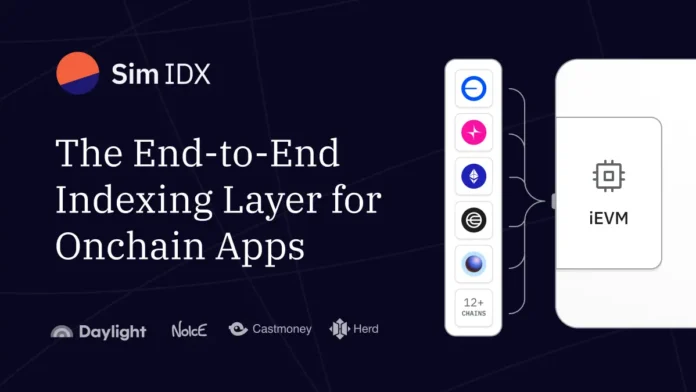
Sim IDX Goes Live: A New End‑to‑End Indexing Layer for On‑Chain Applications
The freshly launched Sim IDX promises to streamline data retrieval for DeFi protocols, NFT marketplaces, and other on‑chain services by delivering a turnkey indexing solution built from the ground up for the decentralized web.
Overview
Today the team behind Sim IDX announced the production launch of its indexing platform, positioning it as an “end‑to‑end” layer that abstracts away the complexities of on‑chain data handling. The service aims to replace the patchwork of custom scripts, third‑party APIs, and off‑chain databases that many developers currently rely on to query blockchain state.
By integrating indexing, transformation, and query APIs into a single offering, Sim IDX hopes to accelerate the development of decentralized applications (dApps) that need fast, reliable access to historical and real‑time blockchain data without compromising security or decentralization.
How Sim IDX Works
- On‑Chain Data Capture: Sim IDX runs a network of validators that ingest blocks from multiple EVM‑compatible chains. The nodes capture events, transaction logs, and state diffs as they appear on chain.
- Schema‑Driven Indexing: Developers define a lightweight schema (similar to GraphQL type definitions) that describes the entities they wish to track—e.g., token transfers, liquidity pool updates, NFT mint events. The platform automatically generates the indexing logic required to materialize these entities.
- Unified Query Interface: Once indexed, data is exposed through a GraphQL endpoint and a REST‑ful API, allowing dApps to retrieve complex relational queries with a single request. The service also supports WebSocket subscriptions for real‑time updates.
- Decentralized Persistence: Unlike many centralized indexing providers, Sim IDX stores indexed data across a distributed storage layer that can be optionally anchored to IPFS or a decentralized file system, preserving the trust‑less ethos of the ecosystem.
Market Context
The need for reliable indexing has become a bottleneck as DeFi protocols scale. Projects such as The Graph, Covalent, and Dune Analytics have pioneered the space, yet each comes with trade‑offs—centralized query servers, limited chain coverage, or steep onboarding curves for developers.
Sim IDX differentiates itself by:
- Broad Chain Support – Initial rollout covers Ethereum, Binance Smart Chain, Polygon, and Arbitrum, with a roadmap that includes non‑EVM chains.
- Developer‑First Tooling – The platform ships with a CLI that scaffolds schemas, runs local test nodes, and integrates directly into popular frameworks (Hardhat, Foundry, Truffle).
- Built‑In Decentralization – By leveraging a validator network and optional decentralized storage, Sim IDX aims to reduce reliance on a single point of failure.
Analysts see this as a natural evolution of the indexing market, where competition is shifting from data completeness toward infrastructural resilience and ease of integration.
Early Adoption
Within hours of the public launch, several projects announced integration plans:
- Aave V3 fork on Polygon – Developers will use Sim IDX to feed real‑time borrowing and repayment events into their risk‑engine dashboards.
- OpenSea‑like NFT marketplace – The platform will index ERC‑721 transfer events to power fast gallery filters and provenance queries.
- Yield farming aggregator – By pulling liquidity pool snapshot data from multiple AMMs, the aggregator can calculate APRs on‑the‑fly without resorting to bespoke scrapers.
Though the platform is still in its early phase, the initial onboarding pipeline suggests a reasonable demand for a more plug‑and‑play indexing solution.
Potential Challenges
- Validator Incentives – Maintaining a robust, decentralised validator set will require a sustainable incentive model. The team has hinted at a token‑based stake‑and‑reward system, but the economics are yet to be detailed.
- Data Freshness vs. Cost – Real‑time indexing can be resource‑intensive. Pricing tiers will need to balance low‑latency guarantees against operational expenses, especially for high‑throughput chains.
- Competitive Pressure – Established players like The Graph have built strong developer communities and extensive documentation. Sim IDX must prove that its added decentralisation and multi‑chain support translate into tangible developer productivity gains.
Key Takeaways
- Launch Milestone – Sim IDX is now live, offering a full stack indexing solution for EVM‑compatible chains.
- Developer Focus – The platform emphasizes schema‑driven indexing, unified GraphQL/REST APIs, and out‑of‑the‑box tooling.
- Decentralisation Emphasis – By using a validator network and optional decentralized storage, Sim IDX aims to reduce central points of failure common in existing services.
- Early Adoption Signals – Initial integrations span DeFi lending, NFT marketplaces, and yield aggregators, indicating broad applicability.
- Risks Remain – Validator incentives, pricing structures, and competition from entrenched indexing providers will shape the platform’s long‑term viability.
As the DeFi ecosystem continues to mature, solutions that streamline on‑chain data access without sacrificing security are likely to become critical infrastructure. Sim IDX’s live launch marks a noteworthy entry into that space, and its performance in the coming months will be a key barometer for the broader push toward truly decentralized application back‑ends.
Source: https://dune.com/blog/sim-idx