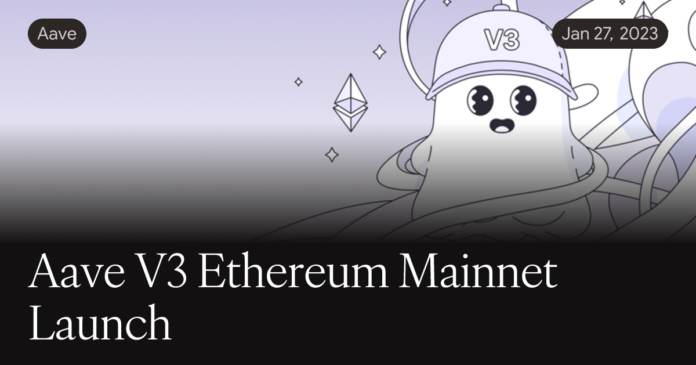
Aave V3 Goes Live on Ethereum Mainnet – What the Upgrade Means for DeFi Users
January 2026 – Aave’s flagship lending protocol has officially rolled out its third‑generation smart‑contract suite on Ethereum, bringing a suite of risk‑mitigation tools, heightened capital efficiency and lower transaction costs to its largest market.
Overview
After a staggered rollout that began in March 2022 on six alternative layers—including Polygon, Avalanche, Arbitrum and Optimism—Aave governance gave the final green light for the Ethereum mainnet deployment last week. The upgrade, dubbed Aave V3, replaces the V2 contracts that have been operating since December 2020 and is positioned as the most substantial improvement to the protocol to date.
The decision was formalised through a community vote on the Aave Governance forum (see proposal #147), where participants approved the migration plan and the associated smart‑contract addresses. The new mainnet contracts are now live at 0xB748952c7BC638F31775245964707Bcc5DDFabFC.
Key Technical Enhancements
| Feature | Description | Benefit |
|---|---|---|
| Supply & Borrow Caps | Upper limits on the amount that can be supplied or borrowed for each asset. | Prevents concentration risk and protects liquidity pools. |
| Risk & Listing Admins | Separate admin roles for managing risk parameters and new asset listings. | Improves governance granularity and speeds up onboarding of novel tokens. |
| E‑Mode (High‑Efficiency Mode) | Allows users to obtain a higher loan‑to‑value (up to ~97 %) when the collateral and borrowed assets belong to the same risk class (e.g., stablecoins, correlated ERC‑20s). | Unlocks more borrowing power for users with correlated positions, reducing capital lock‑up. |
| Isolation Mode | Isolates the liquidity of certain newly listed assets from the main market. | Enables the protocol to accept riskier collateral while shielding the broader pool. |
| Gas Optimisation | Refactored core logic and a slimmer flash‑loan entry point cut gas consumption by roughly 25 % across most actions. | Lowers cost barriers for both retail and institutional participants. |
| Simplified Flash‑Loan Interface | A single‑asset flash‑loan function that minimises transaction overhead. | Makes arbitrage and other composable strategies cheaper and easier to execute. |
The codebase, hosted openly on GitHub, has undergone multiple security audits by firms such as Sigma Prime, Trail of Bits, OpenZeppelin, ABDK and PeckShield, plus formal verification by Certora. All audit reports are publicly available in the repository’s audits folder.
Migration Path for Existing Users
Aave has released a V3 migration tool that bundles the entire transition—deposit, borrow and credit‑delegation steps—into a single transaction on the V2 dashboard. The workflow:
- Choose the positions to move (both supply and borrow).
- Review the new health factor calculations for V2 and V3.
- Approve the migration contract to move aTokens and delegate credit.
- Submit the transaction.
Because the migration leverages flash‑loans and credit delegation, it can settle the old debt and recreate the same exposure on V3 without requiring users to manually unwind positions. The tool recommends moving no more than five assets per transaction to keep gas costs reasonable. Existing V2 contracts remain operational, so users can stay on the older version if they prefer.
Market Impact and Analyst Takeaways
-
Capital Efficiency Gains: The introduction of E‑Mode and higher borrowing caps is expected to increase the utilisation of supplied assets, especially in stablecoin‑heavy markets. Early tests on other chains showed a 15‑20 % uplift in overall loan‑to‑value ratios.
-
Risk Management: Supply/borrow caps and isolation mode give the protocol finer control over asset exposure, which should improve resilience during market stress. This could make Aave more attractive for risk‑averse institutions.
-
Cost Reduction: A 25 % cut in gas fees directly translates into lower entry barriers for smaller users and higher net yields for liquidity providers. In a high‑fee environment, such savings can be a decisive competitive advantage.
-
Liquidity Migration: With roughly $6.5 bn of total value locked (TVL) across V2 and V3 as of early 2023, the migration tool aims to shift a substantial portion of that capital onto the more efficient V3 contracts. How quickly this happens will influence Aave’s market share relative to rivals like Compound and Maker.
- Developer Ecosystem: The open‑source nature of the V3 code, coupled with extensive documentation, invites third‑party developers to build new primitives—particularly around E‑Mode strategies and isolated collateral products.
Quotes
Stani Kulechov, founder and chief executive of the Aave Companies, remarked that the mainnet launch “marks a milestone for DeFi innovation, delivering a flexible architecture that supports novel risk‑mitigation features while lowering gas costs and boosting capital efficiency.”
What’s Next?
- Adoption Tracking: Watch the proportion of TVL that migrates to V3 over the coming weeks. A rapid shift would indicate strong user confidence in the new architecture.
- New Asset Listings: Expect a wave of assets to be introduced under Isolation Mode, expanding the range of collateral options.
- E‑Mode Utilisation: Early adopters may experiment with high‑efficiency borrowing strategies, potentially spawning new yield‑optimisation products.
For developers, the full technical paper, API references and contract addresses are available on Aave’s documentation portal and GitHub repository. The migration contracts for Polygon, Avalanche and Mainnet are also published for audit and integration.
Key Takeaways
- Aave V3 is now live on Ethereum, bringing its most advanced feature set to the protocol’s primary market.
- The upgrade delivers ~25 % lower gas fees, new risk controls (caps, isolation, admin roles) and higher borrowing power through E‑Mode.
- A built‑in migration tool simplifies the transition from V2, though users may opt to stay on the legacy contracts.
- Comprehensive security audits and formal verification underpin the deployment, reinforcing confidence among institutional participants.
Aave’s mainnet V3 launch is poised to reshape liquidity dynamics and risk management practices across the DeFi landscape, setting a new benchmark for borrowing and lending platforms.
Source: https://paragraph.com/@aave/aave-v3-ethereum-mainnet-launch