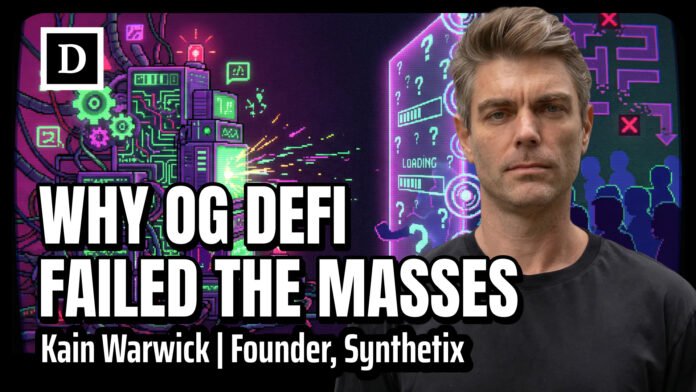
Why the Early “OG” DeFi Projects Fell Short – Insights from Kain Warwick, Founder of Synthetix and Infinex
Camila Russo interviews Kain Warwick on The Defiant Podcast as Infinex completes its INX token sale and prepares for the token‑generation event (TGE).
TL;DR
- Legacy DeFi protocols such as early versions of Synthetix, Compound, and Uniswap pioneered the open‑finance model but struggled with sustainability, governance, and regulatory clarity.
- Kain Warwick attributes most of the shortfall to an over‑reliance on incentive‑driven growth, fragmented liquidity, and a lack of institutional‑grade compliance.
- Infinex’s INX aims to address those gaps by blending decentralized architecture with regulated custodial layers, a clear revenue model, and a tokenomics design that limits perpetual inflation.
- Takeaways: Future DeFi success will likely require hybrid approaches that balance permissionless innovation with compliance, sustainable token economics, and robust on‑chain governance.
1. Context: From “DeFi OG” to a New Frontier
When Kain Warwick first launched Synthetix in 2017, the platform introduced a novel concept—synthetic assets that could mimic the price movement of real‑world commodities, equities, and crypto without requiring the underlying assets to be held on‑chain. The protocol’s staking model, which rewarded SNX holders with newly minted Synths, helped bootstrap liquidity and attracted a passionate community of early adopters.
Fast forward to March 2024: Warwick appears on The Defiant with host Camila Russo to discuss both the lessons learned from those pioneering days and the launch of his latest venture, Infinex (INX). Infinex has just closed a token‑sale that raised roughly $140 million, and the project is gearing up for its token‑generation event (TGE) later this quarter.
Warwick’s reflections provide a useful lens through which to examine why the first wave of “OG” DeFi projects, despite their breakthroughs, failed to deliver on the promises of a fully decentralized, scalable financial system.
2. Core Reasons OG DeFi Stumbled
2.1 Incentive‑Driven Growth Without Sustainable Revenue
The early DeFi boom was powered largely by liquidity mining. Projects emitted massive amounts of native tokens to attract capital, hoping that the resulting activity would later generate fees sufficient to sustain the ecosystem. In practice, many protocols struggled to transition from a subsidized growth phase to a self‑funding operational model.
Warwick pointed out that Synthetix’s early tokenomics assumed a perpetual increase in total value locked (TVL) to offset inflation. When market cycles turned bearish, the mint‑and‑burn mechanism became a source of dilution rather than a stabilising force.
2.2 Fragmented Liquidity Across Chains
The era of single‑chain DeFi left liquidity siloed on Ethereum, with later forays into Polygon, BSC, and Avalanche adding complexity but not truly consolidating capital. This fragmentation made it difficult for users to obtain deep order books and amplified slippage for larger trades.
Warwick cited how the lack of cross‑chain bridges that were both secure and regulated limited the ability of early platforms to scale beyond niche user bases.
2.3 Governance Bottlenecks
Many OG projects implemented on‑chain voting mechanisms that were theoretically decentralized but, in practice, were dominated by large token holders. Low voter participation and opaque proposal pipelines hindered agile decision‑making.
“Governance turned into a popularity contest,” Warwick said. “When a protocol needed to pivot—whether to respond to a bug, adjust fee structures, or comply with new regulations—the process was often too slow or too contentious.”
2.4 Regulatory Uncertainty
Regulators in the United States, Europe, and Asia have increasingly scrutinised DeFi protocols that issue securities‑like tokens or facilitate derivatives trading. Early protocols either ignored these signals or attempted to operate in a legal gray area, exposing themselves to enforcement risk.
Warwick noted that Synthetix’s synthetic asset model attracted the attention of securities regulators because the Synths could be deemed “investment contracts.” The absence of a compliance layer forced several platforms to halt new product launches or delist certain assets.
2.5 Technical Debt
Rapid, code‑first development meant many early contracts were not built with upgradability or audit‑friendliness in mind. The infamous “reentrancy” and “oracle manipulation” attacks that hit the DeFi ecosystem in 2020–2022 exposed the fragility of many OG codebases.
3. How Infinex Positions Itself Differently
Infinex’s INX token sale was marketed not as a “liquidity mining” event but as a capital raise to fund a regulated financial infrastructure. Warwick explained three pillars that separate INX from the first generation of DeFi:
| Pillar | OG DeFi | Infinex (INX) |
|---|---|---|
| Regulatory Integration | Minimal, ad‑hoc compliance | Licensed custodial partner, KYC/AML at onboarding, ongoing reporting |
| Tokenomics | High inflation, rewards tied to minting | Fixed supply, vesting schedules, fee‑based revenue back‑to‑token pool |
| Liquidity Architecture | Single‑chain, fragmented bridges | Multi‑chain aggregation via vetted, insured bridges; on‑ramp/off‑ramp via regulated exchanges |
| Governance | Token‑weighted voting, low participation | Dual‑layer governance: token holders vote on strategic parameters; a DAO council with vetted experts executes day‑to‑day decisions |
| Revenue Model | Protocol fees often negligible | Transaction fees, staking yields, and a “protocol treasury” funded by a % of trading volume |
Warwick highlighted that Infinex’s roadmap includes a compliance‑first “Layer 0” protocol that will act as a gateway for traditional finance institutions to interact with DeFi assets. This is intended to bring institutional capital on‑board without sacrificing the permissionless nature of the underlying smart contracts.
4. Market Reaction and Immediate Outlook
The INX token sale closed with $140 million raised from a mix of retail participants, family offices, and a handful of venture‑backed funds. The price per token was set at $0.80, a modest discount to the secondary market price of comparable regulated tokens.
Analysts at The Block and Messari have flagged the sale as a “pivot point for DeFi”, noting that if Infinex can demonstrate robust compliance while maintaining on‑chain transparency, it could set a template for other legacy projects seeking to reinvent themselves.
Warwick’s TGE is slated for Q2 2024. The event will mint the first 175 million INX tokens, with 30 % allocated to the community treasury, 20 % to the founding team (subject to a four‑year vesting schedule), and 50 % to investors from the token sale.
5. Key Takeaways
| # | Insight |
|---|---|
| 1 | Sustainable token economics are essential. Projects must move beyond perpetual inflationary reward models to fee‑based revenue that can fund long‑term development. |
| 2 | Regulatory alignment is no longer optional. Hybrid models that embed KYC/AML while preserving on‑chain censorship‑resistance can unlock institutional participation. |
| 3 | Cross‑chain liquidity must be addressed with secure, insured bridges and standardized asset representations. |
| 4 | Effective governance requires both broad token‑holder participation and a professional council or DAO layer capable of rapid execution. |
| 5 | Technical robustness — formal verification, upgradable contracts, and comprehensive audits — is a prerequisite for scaling beyond niche markets. |
| 6 | Community trust can be rebuilt through transparency in token distribution and clear, auditable revenue streams. |
6. Looking Ahead
Warwick’s candid discussion on The Defiant underscores that the early DeFi era was a necessary experiment—a proof‑of‑concept that proved decentralised finance could function on public blockchains. However, as the market matures, the “OG” playbook must evolve.
If Infinex successfully demonstrates a regulated, fee‑positive, and community‑driven model, it could catalyse a second wave of DeFi projects that marry crypto’s innovative spirit with the prudence demanded by mainstream finance. Conversely, any misstep—particularly around regulatory enforcement—could reaffirm the cautionary lessons that brought down many of the original OG protocols.
For investors, developers, and policymakers, the conversation with Kain Warwick offers a roadmap: learn from the past, adapt the architecture, and align incentives with long‑term value creation. The next chapter of DeFi may well be defined not by the “wild west” ethos of the 2020 boom, but by a more disciplined, hybrid ecosystem that satisfies both decentralisation advocates and regulatory bodies.
The Defiant Podcast episode featuring Kain Warwick will be released on March 28, 2024. The full transcript and the INX token sale details are available on the podcast’s website.
Source: https://thedefiant.io/podcasts-and-videos/podcast/why-og-defi-failed-or-kain-warwick-founder-of-syntheti