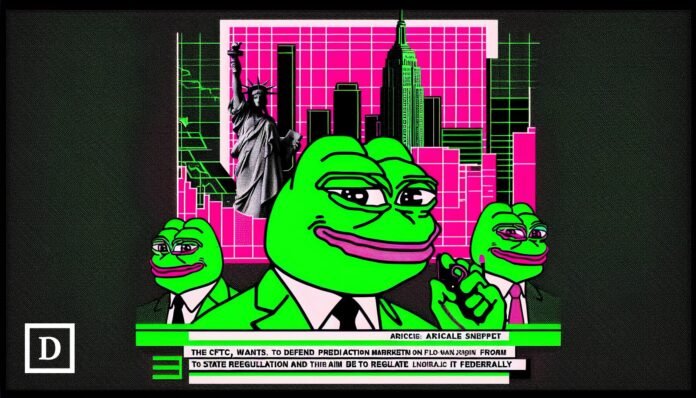
CFTC Calls for Federal Oversight of Prediction‑Market Platforms
Washington, D.C., February 17, 2026 – The U.S. Commodity Futures Trading Commission (CFTC) has taken a decisive step toward consolidating regulatory authority over prediction‑market exchanges, arguing that these platforms belong under the agency’s federal jurisdiction rather than a patchwork of state gambling laws.
Background
Prediction markets—online venues where participants trade contracts whose payouts depend on the outcome of future events—have grown rapidly in the past few years. Several platforms, such as Kalshi and Polymarket, allow users to wager on everything from economic indicators to political results. While the CFTC has already classified contracts on its own regulated market, Kalshi, as derivatives, many state regulators continue to treat these products as gambling.
The tension reached a new high on Feb. 17 when the CFTC submitted a friend‑of‑the‑court brief to the Ninth U.S. Circuit Court of Appeals. The filing supported crypto‑exchange Crypto.com in its legal battle with the Nevada Gaming Control Board, which seeks to ban the company’s prediction‑market offerings under state gambling statutes. CFTC Chairman Mike Selig said the agency can no longer “stand by while overreaching state authorities attempt to erode our exclusive jurisdiction.”
Recent State Actions
- New York: The New York Gaming Commission has sued Kalshi, alleging the platform operates unlawfully within the state. The complaint is part of a broader effort by New York regulators to curb what they view as unauthorized gambling activities.
- Nevada: The Nevada Gaming Control Board is pursuing similar enforcement against both Kalshi and Crypto.com, claiming the contracts should be regulated as gambling rather than derivatives.
- Other states: Additional lawsuits have been filed in jurisdictions such as Illinois and Texas, reflecting a growing pattern of state-level challenges to prediction‑market operators.
Industry Response
Established sportsbook operators DraftKings and FanDuel have recently announced plans to expand into prediction markets, partnering with existing platforms to act as clearinghouses. Their entry adds another layer of complexity, blurring the line between traditional sports betting and derivative‑based forecasting.
Kalshi co‑founder Luana Lopes Lara criticized the state lawsuits, likening the attacks to the historic efforts by banks to undermine the cryptocurrency sector. “What we’re seeing is a coordinated narrative aimed at delegitimizing a legitimate financial product,” she wrote on X in late 2025.
Regulatory Debate
The core of the dispute hinges on classification:
- CFTC stance: Prediction‑market contracts are derivatives—financial instruments that should fall under the federal Commodity Exchange Act. Under this view, the CFTC can ensure market integrity, consumer protection, and systemic risk oversight.
- State gambling regulators: These agencies argue that the contracts function as wagers on uncertain outcomes and therefore belong under state gambling statutes, which typically involve licensing, taxation, and consumer‑protection measures distinct from those applied to derivatives.
Legal scholars note that the resolution could set a precedent affecting not only prediction markets but also emerging products that blend financial and entertainment elements, such as certain types of non‑fungible tokens (NFTs) and tokenized event outcomes.
Key Takeaways
- Federal vs. state: The CFTC is pushing for a unified, nationwide regulatory framework, warning that fragmented state actions could undercut the agency’s authority and create compliance chaos.
- Industry implications: A federal ruling favoring the CFTC would likely streamline compliance for platforms already regulated as derivatives, while potentially raising barriers for new entrants that lack the resources to meet CFTC standards.
- Legal precedent: The outcome of the Ninth Circuit case and parallel state lawsuits will shape how future crypto‑related products are categorized and overseen.
- Market growth: Despite regulatory uncertainty, interest in prediction markets remains high, spurred by mainstream sports‑betting operators expanding into the space.
The debate over prediction‑market regulation is expected to continue throughout the year, with further filings anticipated in both federal courts and state tribunals. Stakeholders are closely watching for a definitive ruling that could either cement the CFTC’s claim to exclusive oversight or empower states to enforce their own gambling frameworks.
This report was prepared with assistance from AI‑driven editorial workflows.
Source: https://thedefiant.io/news/regulation/cftc-says-prediction-markets-should-be-federally-regulated