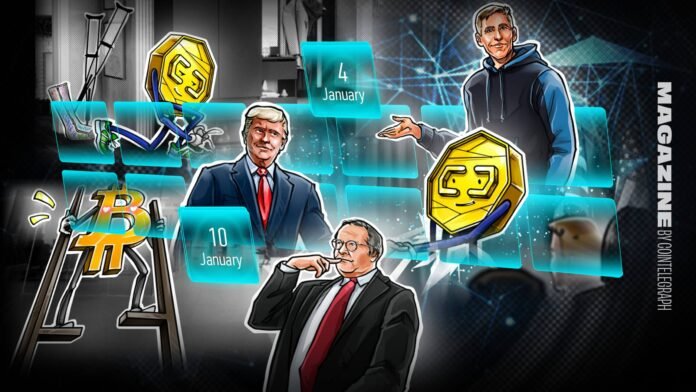
Hodler’s Digest (Jan 4‑10): A Week of Index Consolidation, Stable‑coin Surge, and Shifting Market Sentiment
Cointelegraph Magazine – Editorial Staff
The latest edition of Hodler’s Digest offers a snapshot of the crypto ecosystem as it moves through early‑2026. From a new benchmark that joins two of the world’s biggest exchanges to bullish forecasts for stable‑coin payments, the week’s headlines point to a maturing market that is still subject to political and regulatory turbulence. Below is a synthesized recap, with analysis of what the developments mean for investors and the broader blockchain landscape.
1. Nasdaq‑CME Crypto Index – A Unified Benchmark
Nasdaq and CME Group announced the rebranding of the Nasdaq Crypto Index (NCI) to the Nasdaq CME Crypto Index. The revised index continues to track a basket of leading digital assets—Bitcoin (BTC), Ether (ETH), XRP, Solana (SOL), Chainlink (LINK), Cardano (ADA) and Avalanche (AVAX).
Key takeaways:
- Diversified exposure: By expanding the index beyond Bitcoin, the product caters to investors seeking broader market representation, mirroring the evolution seen in traditional equity and commodity indexes.
- Institutional credibility: A joint offering from two regulated exchanges may accelerate institutional inflows into crypto index funds and ETFs, providing a familiar, transparent vehicle for exposure.
- Potential pricing impact: As index‑linked products gain traction, demand for the constituent tokens could see modest, sustained upside, especially for the mid‑cap assets (e.g., SOL, LINK).
2. Stable‑coin Payments on a Fast‑Track to Trillions
Bloomberg Intelligence projects that stable‑coin transaction volume could climb to roughly $56 billion by 2030, up from $2.9 billion in 2025. The forecast assumes an 80 % compound annual growth rate driven by institutional adoption and the need for stable digital cash in inflation‑hit economies.
Key takeaways:
- Payment‑layer validation: The magnitude of the projected flow positions stablecoins as a core component of global payments infrastructure, rivaling traditional remittance channels.
- Dominance of Tether and USDC: Tether remains the most used for everyday commerce, while USDC leads on decentralized finance platforms, underscoring a bifurcated usage pattern that may affect regulatory focus.
- Geopolitical catalyst: Growth in emerging markets—where local currencies face volatility—could accelerate demand, as highlighted by Artemis co‑founder Anthony Yim.
3. Political Headlines: Trump’s Stance on Sam Bankman‑Fried
In a recent interview with The New York Times, former President Donald Trump clarified that he has no intention of granting a pardon to Sam Bankman‑Fried, the former FTX CEO serving a 25‑year sentence. Trump also dismissed the possibility of clemency for a handful of other high‑profile figures.
Key takeaways:
- Legal certainty for regulators: The absence of a presidential pardon removes a potential source of regulatory ambiguity surrounding FTX’s collapse.
- Reputational impact: Continued punitive enforcement may deter future reckless behavior among crypto executives, reinforcing compliance expectations.
4. Ethereum as the “Linux of Blockchain” – Vitalik Buterin’s Perspective
Ethereum co‑founder Vitalik Buterin likened the platform to the open‑source operating system Linux, emphasizing the shared ethos of modularity and community‑driven development. He stressed that Ethereum’s Layer‑2 solutions serve the same purpose as Linux’s myriad distributions: customized scalability without sacrificing core openness.
Key takeaways:
- Strategic positioning: The analogy bolsters Ethereum’s narrative as the foundational infrastructure for decentralized finance, identity, and governance applications.
- Developer focus: Continued investment in L2 scaling and EVM compatibility remains essential to maintain this “Linux‑like” role and to fend off competition from emerging L1s.
5. BitMine’s Ether Accumulation – A Confidence Signal
Corporate treasury firm BitMine Immersion Technologies resumed large‑scale ETH purchases, buying $105 million worth of Ether in early January. The firm now holds 4.07 million ETH (≈ 3.36 % of total supply) and retains $915 million in cash, aiming for a 5 % stake.
Key takeaways:
- Long‑term bullishness: Institutional buying suggests confidence in Ethereum’s price trajectory despite near‑term volatility.
- Supply dynamics: As BitMine and similar entities increase their on‑chain holdings, the effective circulating supply could tighten, supporting price appreciation.
6. Market Snapshot – Winners, Losers, and Outlook
- Price levels: Bitcoin closed the week at about $90,595, Ether at $3,088, and XRP at $2.09. The total crypto market cap sits near $3.09 trillion.
- Top gainers: Render (+54.7 %), JasmyCoin (+44.6 %), and Polygon (+37.9 %).
- Top decliners: Midnight (‑24.1 %), Canton (‑14.7 %), and ZCash (‑14.3 %).
Analyst perspective: CryptoQuant CEO Ki Young Ju predicts a “boring sideways” period for Bitcoin in Q1 2026, citing drying capital inflows and a shift of investor attention toward precious metals and equities. The forecast aligns with recent outflows from spot Bitcoin and Ether ETFs, which together shed over $1 billion in the first week of January.
7. Prominent FUD and Market Risks
- ETF outflows: Data from SoSoValue shows that spot Bitcoin ETFs experienced $1.13 billion in withdrawals, erasing the modest inflows recorded at the start of the year. Ether ETFs saw a similar $258 million outflow.
- Prediction‑market controversy: A Polymarket user who won roughly $400 k on a bet concerning Venezuelan President Nicolás Maduro’s ouster vanished from the platform, raising concerns over the governance and transparency of crypto‑based prediction markets.
- Political risk: Hedge‑fund titan Ray Dalio warned that the 2026 U.S. midterm elections could overturn current crypto‑friendly policies, potentially reshaping the regulatory landscape.
8. Takeaways for Hodlers
| Theme | Implication |
|---|---|
| Index consolidation | Greater institutional access and legitimacy for diversified crypto exposure. |
| Stable‑coin growth | Expanding real‑world utility; watch for regulatory actions targeting major issuers. |
| Political environment | No pardon for SBF; upcoming U.S. elections could affect policy direction. |
| Ethereum positioning | Continued focus on Layer‑2 development essential to maintain “Linux” status. |
| Corporate treasury activity | Institutional ETH accumulation signals confidence but may increase supply‑side pressure. |
| Market dynamics | ETF outflows and sideways price action suggest cautious sentiment; opportunistic entry points may arise on pullbacks. |
| Risk alerts | Prediction‑market opacity and election‑driven regulatory shifts remain key headwinds. |
Bottom line: The first week of January underscores a dual narrative: structural growth (e.g., stable‑coin adoption, index unification) coexists with short‑term volatility and political uncertainty. Hodlers and institutional participants alike should monitor the evolving regulatory cues, keep an eye on macro‑economic shifts, and consider diversified exposure—potentially via the newly minted Nasdaq CME Crypto Index—to navigate the market’s “boring sideways” phase while positioning for long‑term upside.
Source: https://cointelegraph.com/magazine/donald-trump-sam-bankman-fried-ftx-bitmine-ethereum-holder-hodlers-digest/?utm_source=rss_feed&utm_medium=feed&utm_campaign=rss_partner_inbound