US Lawmakers Hold Hearing on Tokenized Real‑World Assets
House Financial Services Committee examines how existing securities rules should apply to blockchain‑based securities and weighs investor‑protection concerns as Congress debates the Capital Markets Technology Modernization Act of 2026.
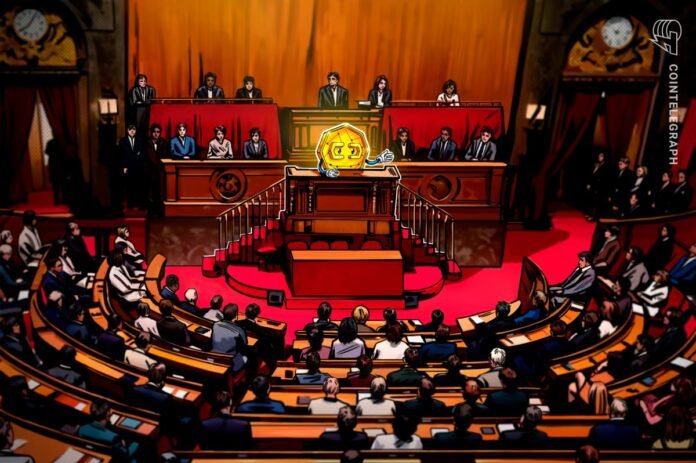
WASHINGTON — On Wednesday, senior executives from the crypto sector testified before the U.S. House Committee on Financial Services about the regulatory treatment of tokenized real‑world assets (RWA). The hearing, convened by Chairman Rep. French Hill (R‑AR), is part of the committee’s review of the Capital Markets Technology Modernization Act of 2026, legislation that would modernize capital‑market infrastructure and clarify the status of digital securities.
The witnesses, representing the Blockchain Association, Nasdaq, the Depository Trust & Clearing Corporation (DTCC), and the permissionless RWA platform Plume Network, argued that tokenized securities should fall under the same investor‑protection and market‑integrity regime that governs traditional securities. They emphasized that the blockchain medium changes the mechanics of record‑keeping but not the substance of the securities themselves.
Tokenization’s Promise
Summer Mersinger, chief executive of the Blockchain Association, described tokenized RWAs as “the digital representation of traditional financial instruments on a blockchain, which can slash transaction costs and accelerate settlement.” By replacing manual ledger entries with immutable timestamps, tokenization could reduce operational overhead, shorten clearance cycles, and potentially increase capital velocity.
Proponents cited recent examples of digital bond pilots that, while still experimental, suggest near‑instant finality and the possibility of removing intermediaries from the post‑trade process. If realized at scale, these efficiencies could reshape the U.S. capital‑markets landscape.
Regulatory Lens: Existing Laws Apply
All witnesses concurred that current securities laws—particularly the Securities Exchange Act and related disclosure, registration, and antifraud provisions—remain applicable to tokenized assets. The argument is that the “technology and the medium used to record securities transactions do not fundamentally alter investor protection laws or jurisdictional oversight,” Mersinger said.
However, the discussion turned to the practicalities of enforcing know‑your‑customer (KYC), anti‑money‑laundering (AML), and sanctions compliance in a blockchain environment.
Compliance on Permissioned vs. Public Chains
Rep. Bill Foster (D‑IL) raised a key concern: “When assets are tokenized, are they placed on private, permissioned networks where participants are vetted, or on public chains that permit anonymous wallets?”
-
Nasdaq’s Position: John Zecca, Nasdaq’s executive vice‑president for legal, risk, and regulatory affairs, explained that Nasdaq’s platform operates on a permissioned blockchain, enabling the exchange to collect KYC data at the protocol level before tokens are issued.
-
DTCC’s View: Christian Sabella, managing director and deputy general counsel at the DTCC, said that identifying information can be embedded directly into the token’s metadata. Because such data is immutable, it would stay attached to the token regardless of whether it later trades on a permissioned or permissionless network.
- Permissionless Solution: Salman Banaei, general counsel for Plume Network, outlined a design where AML and sanctions checks are baked into the token contract, allowing tokens to be frozen if a compliance trigger is hit. He cautioned, however, that regulators currently lack a universal tool to reliably detect wash trades or fully de‑anonymize participants on open networks.
The testimony underscored a split between the technical capability to embed compliance data and the regulatory ability to monitor and enforce it across disparate blockchain ecosystems.
Analysis
The hearing highlights both the enthusiasm for tokenized securities and the lingering uncertainties that could affect their rollout. By framing RWAs as traditional securities recorded on a new ledger, industry leaders aim to sidestep calls for a separate regulatory regime. Yet, the practical challenges of KYC/AML on public blockchains remain a sticking point for lawmakers.
If the Capital Markets Technology Modernization Act of 2026 moves forward with language that explicitly affirms the applicability of existing securities laws to tokenized assets, market participants may gain regulatory clarity, encouraging broader adoption. Conversely, without concrete guidance on surveillance and enforcement mechanisms—especially for permissionless networks—financial institutions may hesitate to integrate tokenized products into their pipelines.
The testimony also reveals a potential regulatory divergence: permissioned platforms can more readily satisfy U.S. compliance expectations, while permissionless projects must develop on‑chain compliance layers that still depend on off‑chain regulatory tools. The evolution of such tools will likely shape the competitive dynamics between established exchanges and emerging blockchain networks.
Key Takeaways
- Regulatory Consensus: Industry witnesses agree that tokenized RWAs should be subject to the same securities regulations that apply to traditional assets.
- Efficiency Gains: Tokenization promises lower transaction costs, faster settlement, and reduced reliance on manual record‑keeping.
- Compliance Gap: Lawmakers remain concerned about KYC, AML, and sanctions enforcement, especially on public blockchains that permit pseudonymous participation.
- Technical Solutions: Both permissioned (Nasdaq, DTCC) and permissionless (Plume Network) platforms claim to embed compliance data at the token level, but regulators lack full‑proof tools for monitoring.
- Legislative Outlook: The Capital Markets Technology Modernization Act of 2026 will be a pivotal piece of legislation; its language on tokenized assets could either accelerate market adoption or impose additional compliance burdens.
As Congress weighs the balance between innovation and investor protection, the crypto industry’s ability to demonstrate robust, blockchain‑native compliance mechanisms may determine how quickly tokenized real‑world assets become a mainstream component of U.S. capital markets.
Source: https://cointelegraph.com/news/us-lawmakers-tokenized-securities-concerns?utm_source=rss_feed&utm_medium=feed&utm_campaign=rss_partner_inbound