


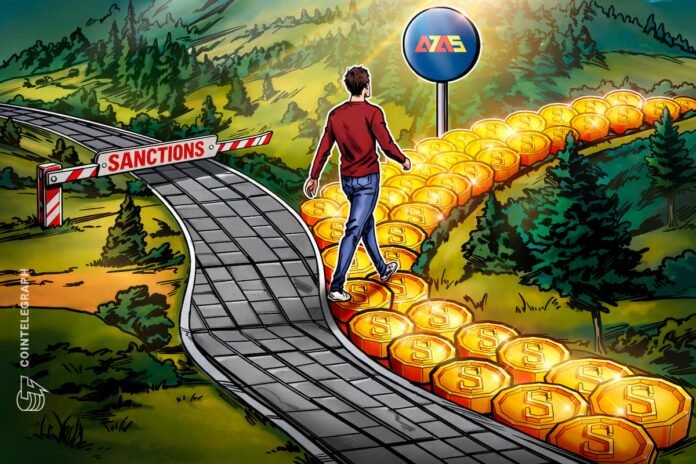
Stablecoin A7A5 Expands Into a Parallel Payment System for Sanctioned Enterprises
By [Author Name] – February 20 2026
A new “shadow” financial layer is emerging
As digital assets continue to weave into the fabric of mainstream finance, a Russian‑origin stablecoin is shaping a parallel ecosystem that enables companies under Western sanctions to move value across borders. The token, known as A7A5, has surged in usage throughout 2025, driving billions of dollars of commercial activity that bypasses traditional banking channels.
Scale of the phenomenon
- $158 billion in illicit cryptocurrency flows were recorded in 2025, the highest level ever documented, according to the 2026 Crypto Crime Report released by TRM Labs.
- Roughly $39 billion of that sum is tied to transactions involving the A7A5 wallet cluster, making it the single largest conduit for sanctions‑related crypto activity.
- Daily trading patterns show a clear business‑week rhythm, with the bulk of transfers occurring Monday‑through‑Friday and peaking at the start of each week, a hallmark of corporate cash‑flow cycles rather than opportunistic darknet activity.
From sanctions to a stablecoin solution
Following Russia’s invasion of Ukraine in February 2022, Western financial institutions quickly cut off Russian entities from the global payment infrastructure. Visa and Mastercard halted international card operations for Russian issuers, and Russian banks were removed from the SWIFT network. In response, the Russian government and private actors turned to alternative mechanisms:
| Development | Impact |
|---|---|
| Mir payment network – expansion after the loss of Visa/Mastercard | Captured a larger share of domestic card transactions. |
| Legislation on digital assets – December 2024 Finance Ministry decree | Authorized the use of “digital financial assets” and domestically mined Bitcoin for foreign trade settlements. |
| Launch of A7A5 – February 2025 | Provided a ruble‑pegged stablecoin designed for cross‑border settlements, initially listed on the Moscow‑based exchange Garantex. |
When Garantex was sanctioned and shut down, trading migrated to the Kyrgyzstan‑based exchange Grinex, which quickly became the de‑facto successor. Additional listings on platforms such as Meer and Bitpapa further amplified liquidity, despite those exchanges also appearing on the U.S. Office of Foreign Assets Control (OFAC) sanctions list.
Who is behind the token?
The A7 financial platform is co‑owned by:
- Ilan Shor, a Moldovan oligarch currently sanctioned and residing in Russia.
- Promsvyazbank (PSB), a state‑linked bank with deep connections to Russia’s defense sector.
Through subsidiaries—including A7‑Agent, A7 Goldinvest, and A71—the group controls assets in strategically important industries such as oil, gas, metals, chemicals, and defense technologies. This ownership structure ties the stablecoin directly to state‑aligned economic interests.
Infrastructure that mimics traditional finance
TRM Labs’ policy head, Ari Redbord, observes that the ecosystem has moved beyond experimental use cases: “State‑aligned actors, professional criminals and sanctions evaders are no longer experimenting with crypto; they’re operating durable financial infrastructure on‑chain.” Chainalysis corroborates this view, noting that the A7A5 network behaves like a conventional corporate payment rail—regular, high‑volume, weekday‑focused transfers that mirror invoices and settlement cycles.
The token’s growth is also reflected in real‑world usage:
- Cross‑border trade – Companies in sectors ranging from metals to chemicals are reportedly settling export‑import contracts with A7A5.
- Bank integration – In July 2025, PSB announced that its cardholders could purchase A7A5 directly through their banking cards, a capability slated for rollout to other Russian banks.
These developments suggest a strategic effort to embed the stablecoin within the existing financial fabric of sanctioned Russian businesses.
Regulatory stance and company response
A7A5’s director for regulatory and overseas affairs, Oleg Ogienko, insists the operation complies with Kyrgyz law, where engagements with Russian firms are not prohibited. The firm claims to implement Know‑Your‑Customer (KYC) and Anti‑Money‑Laundering (AML) checks, alongside regular audits that align with Financial Action Task Force (FATF) standards. In prior statements to Cointelegraph, the company dismissed sanctions‑evasion accusations as “politicized and lacking factual evidence.”
Nevertheless, U.S. authorities continue to list both the token and the exchanges that support it as sanctioned entities, reflecting an ongoing tension between the platform’s self‑portrayal and external enforcement actions.
Analysis: What the rise of A7A5 means for the crypto landscape
- A functional alternative to SWIFT – By offering a ruble‑pegged stablecoin that can be moved instantly on‑chain, A7A5 provides Russian firms with a practical workaround to the banking restrictions imposed after 2022.
- Normalization of sanctioned‑entity crypto usage – The volume and regularity of transactions suggest that crypto is not merely a tool for illicit actors but a legitimate, if controversial, medium for state‑aligned commerce.
- Regulatory challenges – The ability of the token to operate across multiple jurisdictions (Russia, Kyrgyzstan, Kyrgyzstan‑based exchanges) underscores the difficulty of imposing cohesive sanctions on decentralized financial infrastructure.
- Potential spill‑over effects – Should other sanctioned nations adopt similar models, a network of sovereign‑backed stablecoins could emerge, fragmenting the global payments ecosystem and complicating enforcement for agencies like OFAC and the EU’s sanctions bodies.
Key takeaways
| Takeaway | Implication |
|---|---|
| $39 bn in A7A5‑linked flows | Represents a substantial share of global crypto‑based sanctions evasion. |
| Weekday‑centric trading | Indicates corporate‑grade usage rather than illicit, ad‑hoc activity. |
| State‑linked ownership | Highlights a direct nexus between the stablecoin and Russian economic policy. |
| Continued expansion plans | Integration with bank cards and potential onboarding of additional financial institutions could further entrench the token’s role. |
| Regulatory friction | Ongoing sanctions and differing national legal frameworks will shape the token’s future viability. |
Conclusion
A7A5 has evolved from a niche Russian stablecoin into a cornerstone of a shadow financial system that supports sanctioned companies in conducting day‑to‑day commerce. Its rapid adoption, backed by state‑aligned actors and a growing network of exchanges, illustrates how crypto can be repurposed as a strategic economic tool under geopolitical pressure. Whether the token will persist as a viable alternative payment rail, or become the target of intensified enforcement, remains to be seen—but its emergence signals a notable shift in the intersection of cryptocurrency and international sanctions regimes.
Source: https://cointelegraph.com/news/stablecoin-a7a5-parallel-network-sanctioned-companies?utm_source=rss_feed&utm_medium=feed&utm_campaign=rss_partner_inbound













































