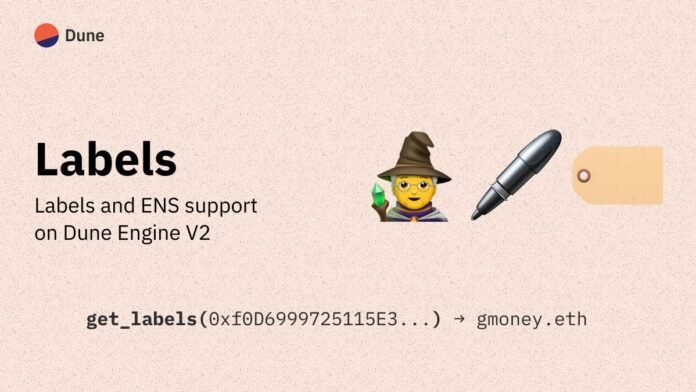
Dune Analytics V2 Introduces On‑Chain Address Labeling and ENS Integration
The new “get_labels()” function brings identity context to raw hexadecimal addresses, expanding analytical possibilities for DeFi researchers and developers.
Overview
Dune Analytics has rolled out a major upgrade to its second‑generation platform: raw blockchain addresses can now be enriched with human‑readable labels and Ethereum Name Service (ENS) names. The feature arrives as part of a broader set of “spells” that allow users to query and attach metadata to on‑chain actors directly within their SQL‑like dashboards.
How the Feature Works
Historically, Dune queries returned only the 0x hexadecimal string that identifies a wallet or contract, leaving the entity behind it opaque. The new get_labels() utility queries a growing repository of pre‑defined categories and returns a list of tags that describe the address’s activity, affiliations, or risk profile. In parallel, get_ens() resolves ENS names where available, translating cryptic strings into recognizable handles.
The launch includes 18 ready‑to‑use label groups, such as:
- Safe – multi‑signature wallets and custodial solutions
- MEV – participants involved in miner‑extractable value strategies
- Airdrop Recipients – wallets that received specific token drops (e.g., OP airdrop)
- OFAC‑Sanctioned – addresses flagged by sanctions lists
- Arbitrage Traders, CEX Bridges, Validators, Hackers, Flashbots, Contracts, Rollups, NFT Actors, Tornado Cash, and various high‑volume NFT trader classifications
- ENS – the primary ENS name linked to the address
Developers can call these functions on any address column, automatically appending contextual metadata to existing visualisations or data pipelines.
Community‑Driven Development
The label system stems from a collaborative effort between Dune’s core team and its open‑source community. A “spellbook” repository on GitHub now hosts the underlying models that assign categories based on transaction histories, token holdings, and other on‑chain signals. Within a week of the repository’s release, community contributors added more than a dozen distinct label sets, accelerating the breadth of coverage.
Every label set includes a contributor attribution column, allowing analysts to credit the individual or team responsible for a particular classification.
Potential Impact on DeFi Analytics
| Aspect | Benefit |
|---|---|
| Risk & Compliance | Quickly filter out sanctioned or suspicious addresses (e.g., OFAC, hackers, Tornado Cash) when constructing compliance dashboards. |
| Market Behaviour | Identify clusters of MEV bots, arbitrageurs, or top NFT traders to study trading patterns or liquidity impacts. |
| User Experience | Replace raw addresses with ENS names or recognizable tags, making reports more digestible for non‑technical stakeholders. |
| Research Speed | Reduce the need for manual address lookup or external API calls, keeping the entire analysis within Dune’s query environment. |
| Community Contributions | Open a pathway for researchers to publish their own classification logic, fostering a richer, crowd‑sourced intelligence layer. |
Analysts can now build more nuanced queries, such as “sum of swap volume executed by addresses labelled ‘safe’” or “track the flow of airdropped tokens into contracts flagged as ‘bridge’.” The combination of labeling and ENS resolution also improves on‑chain attribution, a longstanding pain point in blockchain forensics.
Key Takeaways
- Immediate Availability – The labeling and ENS features are live on Dune V2 and can be accessed via the
get_labels()andget_ens()functions. - Broad Coverage – 18 distinct label categories are provided out of the box, covering security, finance, NFT, and governance personas.
- Open‑Source Model – The underlying “spellbook” models are hosted on GitHub, inviting developers to extend or refine label logic.
- Enhanced Analytics – Researchers gain a plug‑and‑play method for enriching raw address data, streamlining dashboards, and enabling new investigative angles.
- Community‑First Approach – Contributions are visibly credited, reinforcing Dune’s reputation as a collaborative analytics ecosystem.
Looking Ahead
The addition of address labeling positions Dune Analytics as one of the most feature‑rich on‑chain data platforms, bridging the gap between raw blockchain data and actionable insight. As the label library expands—potentially incorporating more nuanced risk scores, protocol‑specific roles, and cross‑chain identifiers—the platform could become a de‑facto standard for compliance‑ready analytics and advanced DeFi research.
Developers and analysts interested in contributing can explore the spellbook repository on GitHub and submit pull requests to add new label sets. The Dune team encourages community participation, emphasizing that the breadth and accuracy of the labeling system will evolve alongside the collective expertise of its users.
With address labels now live, the next wave of blockchain analysis is set to be more transparent, faster, and more collaborative.
Source: https://dune.com/blog/labels-v2