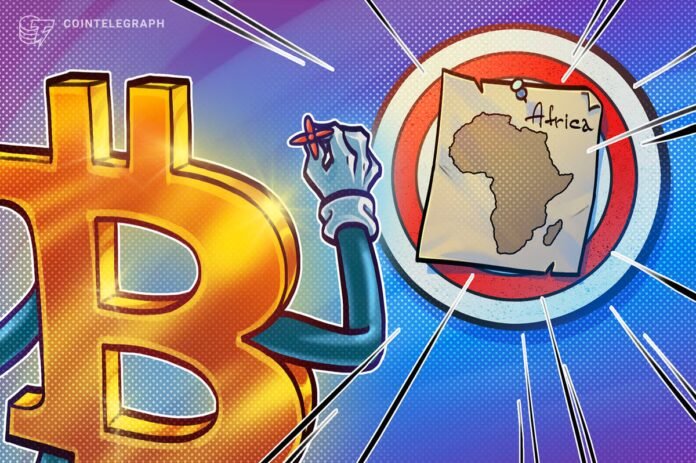
Bitcoin Is Treated As Everyday Money in Parts of Africa, Says Africa Bitcoin Corp Chair
By [Reporter Name] – March 3 2026
Cointelegraph – In a recent appearance on the Coin Stories podcast, Africa Bitcoin Corporation’s executive chairman, Stafford Masie, asserted that Bitcoin is already being used as a medium of exchange in several African markets, rather than solely serving as a long‑term store of value. Masie’s comments highlight a growing divergence between the way the cryptocurrency is perceived in the West—where it is often discussed as an inflation hedge—and how it functions on the ground in parts of Sub‑Saharan Africa.
“Bitcoin is money” – a shift in perception
Masie told host Natalie Brunell that, in certain “circular economies” across the continent, merchants accept satoshis—the smallest unit of Bitcoin—instead of, or alongside, hard‑currency cash. He contrasted the rapid, intraday devaluation that many African economies experience with the relatively modest 4‑5 % inflation rates typically cited by western analysts. “When you talk about debasement, you mention a few percent a year; we see the same percentage erode in a single afternoon,” he said.
According to Masie, the phenomenon is propelled by Africa’s youthful demographics. More than 25 % of the continent’s population is under the age of 20, and younger consumers are quickly adopting mobile and digital technologies while bypassing legacy banking infrastructure. In this environment, Bitcoin is framed not just as “digital gold” but as “pristine capital”—a decentralized, immutable financial substrate that can’t be confiscated or arbitrarily inflated.
Data backs the narrative
Masie’s observations are supported by recent blockchain analytics. Chainalysis reported that from July 2024 to June 2025, Sub‑Saharan Africa recorded on‑chain inflows exceeding $205 billion, marking a 52 % year‑on‑year increase and positioning the region as the third‑fastest growing crypto market worldwide. March 2025 alone saw monthly transaction volume approach $25 billion, largely driven by heightened activity in Nigeria after a sharp local currency devaluation.
The report also underscored the retail‑driven nature of the market: transactions under $10,000 accounted for more than 8 % of total value transferred in the region, compared with roughly 6 % globally. Institutional flows, particularly stable‑coin transfers linked to cross‑border trade between Africa, the Middle East and Asia, were pronounced in both Nigeria and South Africa.
Former UN Under‑Secretary‑General Vera Songwe, speaking at the World Economic Forum earlier this year, echoed these trends. She noted that stablecoins are increasingly viewed as a cheaper alternative for remittances—costing as little as $0.06 per $100 transferred—relative to traditional channels that can charge $6 per $100. With inflation surpassing 20 % in a dozen African states and an estimated 650 million people still unbanked, such low‑cost digital assets are becoming both a payments rail and a hedge against currency pressure.
What the shift means for the broader crypto ecosystem
-
Regional usage patterns are diverging – While Bitcoin’s narrative in North America and Europe remains dominated by store‑of‑value arguments, African users are incorporating satoshis directly into daily commerce, a trend that could influence product development (e.g., point‑of‑sale integrations) and regulatory approaches.
-
Mobile‑first adoption accelerates – The continent’s rapid embrace of smartphones and mobile money platforms mirrors the earlier leapfrogging of traditional banking services, suggesting that crypto solutions that prioritize lightweight, offline‑friendly wallets may gain traction.
-
Stablecoins as a bridge – The prevalence of multimillion‑dollar stablecoin flows points to a complementary role for pegged assets in facilitating trade and remittances, while Bitcoin serves as a “digital sovereign reserve” for individuals wary of fiat debasement.
- Policy implications – Governments facing hyperinflation may need to reassess the regulatory treatment of cryptocurrencies, balancing consumer protection with the potential benefits of a resilient, decentralized payments system.
Key takeaways
| Insight | Implication |
|---|---|
| Bitcoin used as everyday currency – Merchants in certain African markets accept satoshis directly. | Encourages development of merchant‑friendly tools and localized education. |
| Rapid on‑chain growth – $205 bn in inflows, 52 % YoY increase (July 2024‑June 2025). | Signals a maturing market that could attract institutional liquidity. |
| Retail‑driven transactions – >8 % of value under $10 k, higher than global average. | Highlights the importance of micro‑payment solutions. |
| Stablecoins complement Bitcoin – Used for cross‑border trade and cheap remittances. | Suggests a dual‑layer ecosystem: Bitcoin as “pristine capital,” stablecoins as “transactional medium.” |
| Youthful demographics – Over one‑quarter of the population under 20. | Potential for sustained demand as digital natives enter the workforce. |
Outlook
Masie’s description of a continent “living before and after 2008” underscores the transformative potential of decentralized finance in regions where fiat currencies are perceived as unreliable. As on‑chain activity continues to outpace traditional financial flows, the African crypto market may become a proving ground for new models of money—ones that blend the store‑of‑value attributes of Bitcoin with the transactional efficiency of stablecoins.
Stakeholders—including developers, payment processors, and regulators—will need to monitor these developments closely. If the current trajectory holds, Africa could evolve from a peripheral adopter of crypto to a central hub where digital assets serve both as everyday cash and as a safeguard against fiscal instability.
Source: https://cointelegraph.com/news/where-i-come-from-bitcoin-is-money-says-africa-bitcoin-corp-chair-stafford-masie?utm_source=rss_feed&utm_medium=feed&utm_campaign=rss_partner_inbound