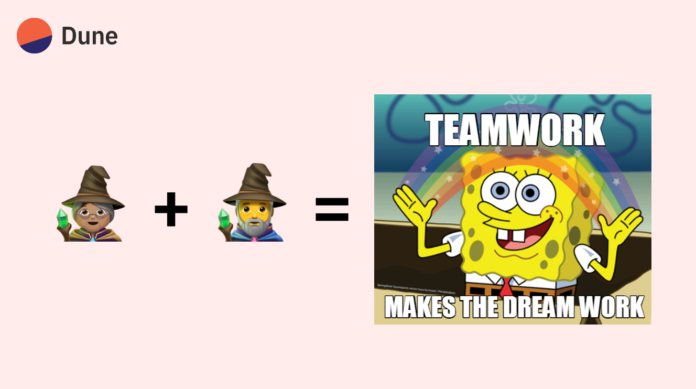
Teamwork Makes the Dreamwork: How “Teams” Are Shaping Collaboration on the Wizards Platform
By [Your Name] – March 4 2026
The Wizards ecosystem, a rapidly expanding suite of DeFi tools and community‑driven applications, has announced a new feature set called Teams. The rollout follows a sustained increase in user adoption and reflects a broader trend in the crypto space toward collective governance and shared incentive structures. Below we break down what Teams are, the strategic drivers behind their launch, and who stands to benefit.
What Are Teams?
Teams are a native construct on the Wizards network that groups individual wallet addresses into a single logical unit. Each Team operates under a shared identity, enabling members to pool assets, coordinate voting power, and distribute rewards according to pre‑defined rules. The architecture is built on the existing Wizards smart‑contract framework, ensuring that all actions—whether token staking, liquidity provision, or governance proposals—are recorded on‑chain and transparent to the broader community.
Key functional attributes include:
| Feature | Description |
|---|---|
| Joint Vault | Members deposit tokens into a common pool that the Team can deploy in liquidity mining, yield farming, or other protocol activities. |
| Coordinated Governance | Voting weight is aggregated, allowing the Team to cast a single, proportionate vote on protocol proposals. |
| Reward Allocation Rules | Smart‑contract‑enforced splits (e.g., equal, performance‑based, or custom percentages) dictate how earnings are distributed among participants. |
| Membership Management | Admins can add or remove members, set onboarding criteria, and enforce KYC or reputation thresholds if desired. |
The design deliberately avoids any centralization of control; the underlying code remains open‑source and is auditable by anyone.
Why Wizards Introduced Teams
-
Scaling Collaborative Activity
As the Wizards user base grows, many participants are looking for ways to coordinate larger capital deployments without sacrificing the on‑chain auditability that DeFi promises. Teams provide a structured mechanism for collective action, mirroring the collaborative dynamics seen in traditional venture funds or DAO collectives. -
Enhancing Governance Efficiency
The Wizards protocol relies on token‑based voting to evolve its roadmap. Individual, fragmented voting can lead to low turnout and sub‑optimal decision‑making. By consolidating votes, Teams can increase participation rates and reduce the latency of proposal execution. -
Improving Incentive Alignment
Shared reward schemes encourage members to stay engaged over longer horizons. This mitigates the “pump‑and‑dump” cycles sometimes observed in solo staking arrangements, fostering more stable liquidity provision. - Expanding the Platform’s Appeal
Teams cater to a broad spectrum of actors—from crypto‑savvy hobbyists who want to pool resources with friends, to institutional players seeking a compliant, on‑chain vehicle for joint investment. By lowering the technical barrier to form such groups, Wizards aims to capture a larger share of the collaborative finance market.
Who Can Form a Team?
- Individual Retail Users – Small‑scale investors can band together to meet minimum staking thresholds or gain enough voting weight to influence protocol upgrades.
- Community Projects & DAOs – Existing decentralized autonomous organizations can adopt Teams as a sub‑layer for specific initiatives (e.g., a liquidity‑driving task force).
- Institutional Partners – Hedge funds, family offices, and other regulated entities may use Teams to meet internal compliance requirements while still interacting with the open protocol.
The system does not enforce a mandatory identity verification process, but developers can integrate optional KYC modules if a Team chooses to impose stricter entry criteria.
Analysis: Potential Impacts on the Wizards Ecosystem
Network Effects
By enabling groups to combine capital, Teams are likely to accelerate the amount of assets flowing into Wizards’ liquidity pools. A higher total value locked (TVL) generally translates into stronger price stability for native tokens and a more attractive environment for external developers.
Governance Centralization Risk
While aggregation can streamline voting, it also raises the specter of power concentration. If a few large Teams dominate the voting landscape, the protocol could drift toward the interests of a minority. Wizards mitigates this by providing on‑chain analytics tools that track voting distribution and by encouraging the formation of multiple, competitive Teams.
Tokenomics Adjustments
Reward distribution models for Teams will interact with the platform’s inflation schedule. If Teams consistently out‑perform solo stakers, the effective yield for individual participants might decline, prompting a shift in user behavior toward collaborative strategies.
Regulatory Outlook
The Team construct resembles a collective investment scheme. Jurisdictions that scrutinize pooled investments may view Teams as falling under existing securities frameworks. Wizards’ open‑source, permissionless design offers transparency, but participants should stay aware of local regulatory interpretations.
Key Takeaways
- Teams provide a programmable framework for pooled capital, joint governance, and shared reward distribution on the Wizards DeFi platform.
- The feature addresses scalability, governance efficiency, and incentive alignment, aiming to attract both retail and institutional collaborators.
- Potential upside includes higher TVL, stronger network effects, and more decisive protocol upgrades, yet there is a concurrent risk of voting power concentration.
- Participants should monitor emerging analytics on Team voting influence and consider regulatory implications of on‑chain pooling.
As Wizards continues to mature, Teams could become a cornerstone of how decentralized finance projects coordinate large‑scale actions without sacrificing transparency—a development worth watching for investors, developers, and policymakers alike.
Source: https://dune.com/blog/dreamwork