Building Backend Data Infrastructure with Ben Smith: A Deep‑Dive into the Cow Protocol Dune Client
By [Your Name]
Date: March 4 2026
The decentralized finance (DeFi) ecosystem continues to grapple with the need for reliable, scalable data pipelines. In a recent workshop, Ben Smith—a data engineer at Cow Protocol—demonstrated how the team’s new Python‑based Dune client can help developers and analysts tap the full potential of Dune’s freshly released API. The open‑source library, now available on GitHub, promises to streamline the extraction, transformation, and loading (ETL) of on‑chain data for a range of DeFi applications.
Workshop Overview
During the session, Smith walked participants through the architecture of the client, highlighting its modular design and how it abstracts Dune’s HTTP endpoints into intuitive Python objects. Attendees learned how to:
- Authenticate securely with Dune’s API using API keys.
- Submit custom SQL queries programmatically and retrieve results in pandas‑compatible data frames.
- Cache query results locally to reduce latency and API usage costs.
- Integrate the client into existing data pipelines, from back‑testing strategies to real‑time dashboards.
The codebase, which can be cloned from the Cow Protocol GitHub repository, includes comprehensive documentation, example notebooks, and a test suite that ensures compatibility with current and future Dune API versions.
Why the Dune API Matters
Dune Analytics has emerged as one of the most popular platforms for querying blockchain data. Its public API, launched earlier this year, offers developers direct programmatic access to the same indexed datasets that power Dune’s web UI. Prior to the API’s release, many teams relied on manual CSV exports or bespoke scraping tools—approaches that are error‑prone and difficult to maintain at scale.
Smith’s client capitalizes on the API’s capabilities by providing a developer‑friendly wrapper that eliminates repetitive boilerplate code. By handling authentication, pagination, and rate‑limit management internally, the library lets engineers focus on the analytical logic rather than the intricacies of HTTP requests.
Implications for DeFi Infrastructure
The emergence of a robust, open‑source client for the Dune API is a noteworthy development for several reasons:
-
Accelerated Data‑Driven Development – Teams can prototype and iterate faster when they can pull clean, query‑able data directly into Python environments. This reduces the time between hypothesis generation and back‑testing.
-
Cost Efficiency – By caching query results and optimizing request patterns, the client helps projects stay within Dune’s usage quotas, potentially lowering operational expenses.
-
Standardization – A shared library promotes consistent data handling practices across the DeFi community, making it easier to audit, replicate, and audit analytical workflows.
- Community Expansion – The open‑source nature encourages contributions that may extend the client to support additional features, such as asynchronous execution or integration with other data warehouses.
Expert Takeaways
| Takeaway | Rationale |
|---|---|
| Adopt the client early | Early integration can future‑proof data pipelines as Dune expands its query limits and adds new blockchain datasets. |
| Leverage caching | Implementing local storage for query results minimizes redundant calls, improves performance, and respects API rate limits. |
| Combine with other tools | Pairing the client with orchestration frameworks (e.g., Airflow, Prefect) enables automated, scheduled data refreshes for dashboards and alerts. |
| Monitor API updates | Dune’s API is still evolving; staying abreast of version changes will help avoid breaking changes in downstream services. |
| Engage with the community | Contributing to the repository or opening issues can shape the client’s roadmap and ensure it meets broader industry needs. |
Looking Ahead
As DeFi applications become more data‑intensive—whether for on‑chain risk monitoring, automated market‑making strategies, or compliance reporting—accessible, high‑quality data infrastructure is no longer a luxury, but a necessity. Ben Smith’s presentation showcased a practical tool that lowers the technical barrier to tapping Dune’s powerful analytics engine.
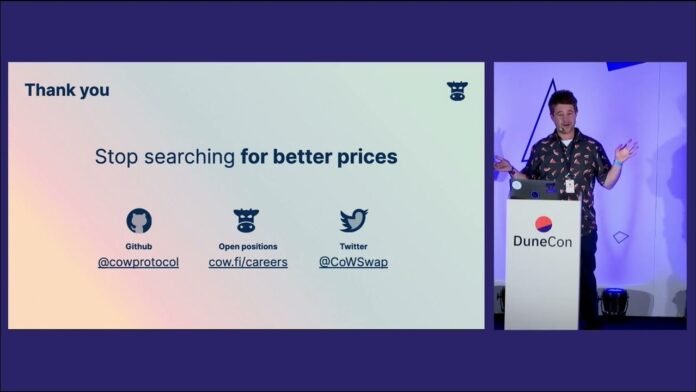
Developers interested in experimenting with the client can clone the repository from the Cow Protocol GitHub page and follow the included quick‑start guide. For ongoing insights and updates, Smith shares his thoughts on Twitter, where he frequently posts tips on data engineering and DeFi analytics.
The workshop reinforces a growing trend: open‑source tooling, built on top of robust data platforms like Dune, is shaping the next generation of DeFi infrastructure.
Source: https://dune.com/blog/building-backend-data-infrastructure-with-ben-smith