Dune Digest 001 – A Data‑Driven Snapshot of the DeFi Landscape (Mar 2024)
By the Dune Analytics team
Overview
The inaugural edition of Dune Digest aims to cut through the ever‑growing noise in the blockchain ecosystem and deliver concise, on‑chain insights for traders, builders, investors and analysts. This week’s edition highlights a blend of protocol expansions, governance outcomes, trading milestones, and the continuing march of real‑world asset tokenisation.
1. Fluid’s Leap onto Polygon
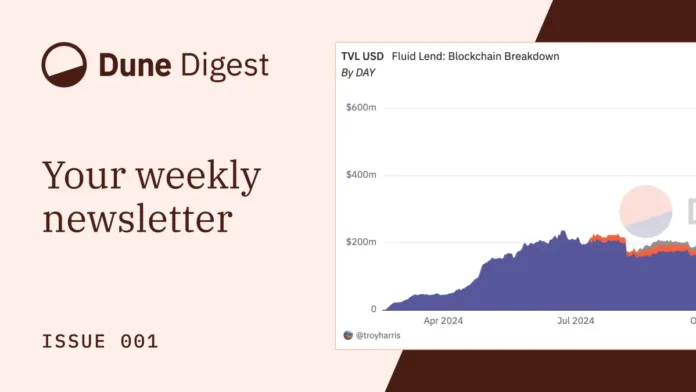
After a rapid ascent on Ethereum—where it amassed more than $550 million in total value locked (TVL) within months of its launch—Fluid, the unified liquidity and lending platform, announced its deployment on Polygon PoS on March 11.
- Initial TVL on Polygon: $23 million (in just a few days)
- Incentive package: 1.5 million POL tokens aimed at USDC, USDT, ETH, wstETH and POL markets
- Strategic intent: Having already eclipsed Curve in DEX trading volume earlier this year, Fluid now targets the lending segment, positioning itself as a direct competitor to incumbents such as Aave.
Analysis: Polygon’s lower transaction costs and growing user base provide a fertile ground for Fluid to diversify its liquidity sources. The modest but swift $23 million lock‑up suggests strong appetite for the protocol’s multi‑asset offerings, though the incentive size indicates Fluid will need sustained user acquisition to close the gap with larger lenders.
2. Solana Governance Misses the Two‑Thirds Threshold
The Solana community voted on SIMD‑0228, a proposal to shift the network’s token emissions from a fixed schedule to a market‑driven model. Despite a high voter turnout—910 validators representing 74 % of staked votes—the measure fell short of the required super‑majority, garnering just 58 % support.
- Proposed impact: Reduce the 4.6 % inflation rate to sub‑1 % levels, increasing SOL scarcity.
- Potential downside: Projected staking yields would drop from roughly 8 % to 1.34 %, raising concerns about validator decentralisation, especially for smaller operators.
- Validator split: Larger validators (those casting more than 500 k votes) backed the change at a 60 % “Yes” rate, while smaller validators showed only 30 % favour.
Analysis: The outcome underscores a classic tension in proof‑of‑stake networks—balancing token scarcity with sufficient incentives to keep the validator set diverse. The clear divide between big and small validators may foreshadow future governance battles, as smaller participants could rally for alternative incentive structures to protect decentralisation.
3. Hyperliquid: Record‑Breaking Volume Meets Risk‑Management Stress
Hyperliquid achieved a historic milestone in early March, surpassing $1 trillion in cumulative trading volume and reporting an estimated $600 million in annualised revenue. The platform now commands more than 69 % of the perpetuals market—a dramatic rise from 30 % six months prior.
However, a massive liquidation event on March 12 exposed vulnerabilities:
- A single leveraged (50×) ETH long position of $271 million was force‑closed, costing the platform’s vault roughly $4 million while the trader walked away with $1.8 million in profit.
- The incident triggered a net outflow exceeding $166 million, nudging TVL down to $2.26 billion from an all‑time high of $2.58 billion.
Analysis: The episode highlights the trade‑off between aggressive leverage offerings and capital protection. While Hyperliquid’s dominance in perpetuals is undeniable, the platform’s risk parameters may need tightening to prevent outsized losses that can erode user confidence and liquid assets.
4. Compound Re‑Enters Polygon via Morpho Blue
On March 13, Compound launched a suite of lending vaults on Polygon, leveraging the Morpho Blue optimizer. The rollout was supported by $3 million in COMP and POL incentives. Within 24 hours, users deposited roughly $12 million, with $214 k posted as collateral and $51 k borrowed.
- Competitive landscape: With Aave signalling a pullback from Polygon, Morpho (both a partner and a competitor) could soon become the dominant lending protocol on the network.
- Strategic implications: The rapid inflow demonstrates that Polygon’s lender‑friendly environment still attracts capital, yet Compound’s long‑term relevance will hinge on its ability to differentiate from Morpho’s native offerings.
Analysis: Compound’s partnership with Morpho signals a pragmatic approach—leveraging existing optimisation tech rather than rebuilding from scratch. The speed of user adoption suggests that the incentive structure resonated, but the limited borrow volume hints at early‑stage traction; sustained growth will require broader asset support and competitive rates.
5. BlackRock’s BUIDL Tokenised Treasury Fund Breaks the $1 B Barrier
BlackRock’s BUIDL token, a fully on‑chain representation of U.S. Treasury securities, crossed the $1 billion TVL milestone, reinforcing the growing institutional appetite for real‑world asset (RWA) tokenisation.
- Asset distribution: 82 % of the TVL resides on Ethereum, with Avalanche and Aptos each holding about 5.3 % and the remainder spread across Polygon, Optimism and Arbitrum.
- Ecosystem integration: Ethena’s stablecoin USDtb is approximately 90 % backed by BUIDL, linking the fund to yield‑generating strategies.
Analysis: The achievement marks a pivotal moment for on‑chain RWA products, indicating that regulated, institutional‑grade assets can attract sizable capital when tokenised efficiently. Ethereum’s dominance reflects the network’s perceived security and compliance infrastructure, while the diversification onto other roll‑ups hints at the gradual migration of institutional flows toward more cost‑effective layers.
Key Takeaways
| Insight | Implication |
|---|---|
| Fluid’s Polygon debut – $23 M TVL and 1.5 M POL incentives | Early traction shows promise, but the protocol must expand beyond incentives to challenge established lenders. |
| Solana’s emission proposal failure – 58 % support, split by validator size | Governance mechanisms may need reform to reconcile the interests of large and small validators. |
| Hyperliquid’s growth vs. risk event – >$1 T volume, $4 M vault loss | Dominance in perps is clear, yet risk controls must evolve to protect against extreme liquidations. |
| Compound + Morpho Blue on Polygon – $12 M deposited in 1 day | Incentives worked; long‑term success depends on competitive borrowing rates and broader asset coverage. |
| BUIDL $1 B TVL – 82 % on Ethereum, cross‑chain presence | Institutional confidence in tokenised treasuries rises; Ethereum remains the primary hub for RWA deployment. |
Looking Ahead
The data‑first approach of Dune Digest underscores how quickly the DeFi terrain can shift—from protocol expansions and governance outcomes to massive trading volumes and the mainstreaming of tokenised real‑world assets. As the market matures, the ability to parse on‑chain metrics in real time will become an essential tool for anyone seeking to navigate the space responsibly.
The data must flow.
— The Dune Analytics Team
Source: https://dune.com/blog/dune-digest-001