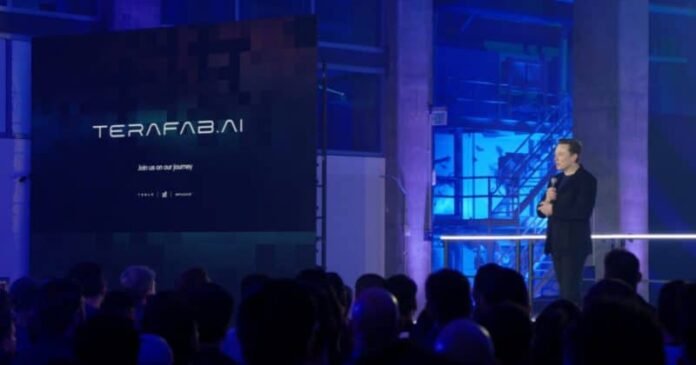
Elon Musk Announces “Terafab” – a Terawatt‑Scale Chip Fab Designed for Space‑Based AI Compute
By [Your Name], Crypto Briefing – March 22 2026
TL;DR
- Musk’s new “Terafab” aims to produce enough AI silicon to deliver 1 TW of compute a year, roughly 50 × the current world‑wide AI‑chip output.
- The venture is a joint effort of Tesla, SpaceX and xAI, operating under Musk’s aerospace umbrella.
- Two chip families are planned: one for on‑board inference in Tesla’s robotics and autonomous fleet, and a second hardened for the harsh environment of orbit.
- The bulk of the processing is intended to live on solar‑powered satellites, with Starship’s reusable launch system providing the logistics backbone.
- If realised, the project could reshape the AI‑hardware supply chain, affect the economics of crypto mining, and accelerate Musk’s broader vision of a space‑faring civilization.
What is Terafab?
During a recent SpaceX broadcast, Elon Musk unveiled a concept he calls the Terafab – a massive, vertically integrated semiconductor plant that would house every stage of chip creation, from mask design to testing and rapid redesign. By collapsing the fragmented steps that currently dominate the global foundry ecosystem, Musk argues the facility could shave months off the typical design‑to‑fab cycle.
The first footprint is slated for Texas, where state officials have reportedly pledged support for the initiative. While details on funding and construction timelines remain sparse, the placement aligns with existing SpaceX and Tesla manufacturing hubs in the region.
Why Build in Space?
Musk contends that the power ceiling on Earth—U.S. electricity generation hovers around 0.5 TW—makes a terawatt‑scale AI operation infeasible on the ground. Instead, the plan calls for AI‑satellites powered directly by sunlight, sidestepping terrestrial grid constraints.
A prototype “mini‑satellite” would initially output about 100 kW, with successive generations scaling to the megawatt class. To reach the 1 TW annual target, Musk estimates that roughly 10 million tonnes of hardware would need to be launched each year, assuming a productivity of 100 kW per tonne.
The launch equation
- Current Starship‑V3 can carry ≈ 100 t to orbit; the upcoming V4 is projected to double that to 200 t per launch.
- Launch costs have already fallen from the Shuttle era’s $65 000/kg to $1 000–$2 000/kg with Starship, and Musk says further optimisation could push the price down to $100–$200/kg.
- At that price point, a space‑based compute infrastructure could become cheaper than building equivalent data centres on Earth within the next two to three years.
Starship’s full reusability is therefore a critical enabler, according to Musk, for moving the massive payloads required for the Terafab ecosystem.
Two Chip Families, Two Frontiers
-
Edge‑Inference Chips – Tailored for Tesla’s autonomous vehicles, the upcoming Optimus humanoid robots, and the Cybercab service. The chips will focus on low‑latency, power‑efficient inference to keep processing close to the sensor suite.
- Space‑Qualified Chips – Built to tolerate high‑energy particle fluxes and operate at higher temperatures, reducing the need for bulky radiators on orbiting platforms. These devices would form the computational core of the solar AI satellites.
Musk envisions that robot production could climb to 1–10 billion units per year, dwarfing the current global vehicle output of around 100 million units annually. The demand for edge chips would therefore be a major driver of the Terafab’s volume.
How Big Is the Gap?
- Global AI compute capacity today is estimated at ≈ 20 GW per year.
- The combined capacity of all existing semiconductor fabs represents only about 2 % of the throughput needed for a 1 TW/year Terafab.
- Existing foundries can expand, but Musk asserts their growth rates fall far short of the scale required for his vision.
Musk summed up the strategic imperative: “Either we build Terafab, or we won’t have the chips we need.”
Analysis – What It Means for Crypto and the Wider Tech Landscape
| Aspect | Potential Impact |
|---|---|
| AI compute vs. Crypto mining | A terawatt‑scale, solar‑powered compute platform could undercut the economics of electricity‑intensive proof‑of‑work mining. Projects that still rely on PoW may see higher relative costs, accelerating the shift to proof‑of‑stake or other low‑energy consensus mechanisms. |
| Supply‑chain independence | By internalising the entire fab flow, Musk reduces reliance on third‑party foundries (e.g., TSMC, Samsung). This could create a new, vertically‑integrated hardware pipeline that competes with the traditional semiconductor ecosystem. |
| Capital intensity and risk | The launch logistics alone—tens of millions of tonnes per year—represent an unprecedented capital outlay. Delays in Starship’s payload capacity or launch‑cost reductions could significantly postpone the compute rollout. |
| Regulatory & environmental concerns | Deploying a constellation of high‑power AI satellites raises questions about orbital debris, spectrum allocation, and the environmental impact of massive launch cadence. Regulators may impose constraints that affect the timeline. |
| Strategic advantage for Space‑AI | If successful, the Terafab could give Musk’s trio of companies a decisive lead in AI hardware, especially for applications that demand near‑real‑time processing (e.g., autonomous navigation, robotic control). This might translate into new revenue streams and stronger network effects for services like xAI’s language models. |
Timeline Outlook
- Short‑term (0‑12 months): Finalise Texas fab design, secure state incentives, begin procurement of Starship payload upgrades. |
- Medium‑term (1‑3 years): Commence silicon production, launch pilot “mini‑sat” units, iterate on chip designs through the integrated feedback loop. |
- Long‑term (3‑5 years+): Scale to megawatt‑class satellites, achieve near‑terawatt annual compute, explore lunar‑based manufacturing and mass‑driver logistics. |
Key Takeaways
- Terafab targets 1 TW of AI compute per year – a scale 50 × today’s global AI‑chip output.
- Two chip lines: edge‑inference for Tesla robotics and space‑hardened silicon for orbital AI servers.
- Space‑based deployment leverages solar power and Starship’s reusable launch system to bypass Earth’s electricity ceiling.
- Economic viability hinges on reducing launch costs to $100–$200 /kg, a target Musk believes is reachable within a few years.
- Implications for crypto include potential cost pressures on PoW mining and heightened interest in low‑energy consensus models.
- Risks are significant: massive launch cadence, regulatory scrutiny, and the technical challenges of fabricating and operating chips in orbit.
If Musk’s timeline holds, the Terafab could become a cornerstone of a new, space‑centric compute infrastructure—one that not only powers next‑generation AI but also reshapes the financial and environmental calculus of high‑performance computing across the planet and beyond.
Disclosure: This article was edited by Vivian Nguyen. For details on our editorial standards, see our Editorial Policy.
Source: https://cryptobriefing.com/terafab-ai-compute-space-unveiled/