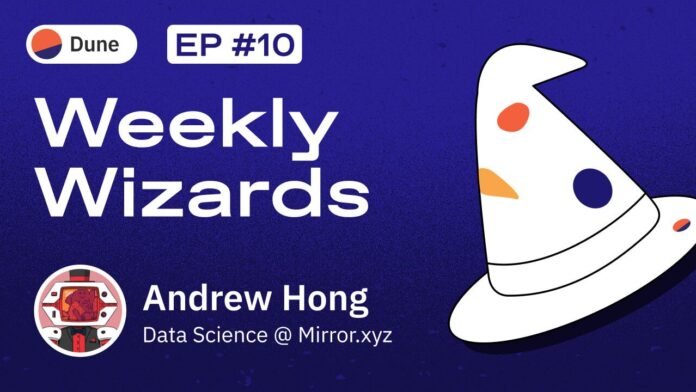
Mirror.xyz’s Data‑Science Lead Andrew Explores Web‑3 Education, DAOs and the Emerging Job Market
Episode 10 of the “Web‑3 Career Pathways” podcast breaks down how data expertise is reshaping opportunities in decentralized ecosystems.
Overview
In the latest installment of the “Web‑3 Career Pathways” series, Andrew—head of data science at Mirror.xyz—spoke at length about the rapid evolution of web‑3 education, the growing influence of decentralized autonomous organizations (DAOs), and practical strategies for landing a role in the sector. The conversation, recorded as Episode 10, highlighted the convergence of technical skill‑building, community‑driven governance, and talent pipelines that are defining the next wave of blockchain‑based employment.
From Data Science to Community Building
Andrew’s background blends traditional data‑science experience with a focus on on‑chain analytics. At Mirror.xyz, he leads a team that builds tools for tracking content creation, token‑minting, and community engagement on the platform’s decentralized publishing suite. According to Andrew, “the real value proposition for any data engineer in web‑3 is the ability to translate raw blockchain activity into actionable insights for creators, investors, and DAO participants.”
His work has positioned him as a central figure in what he calls the “web‑3 data degens” community—a loosely organized network of analysts, researchers, and developers who share methodologies, open‑source scripts, and job leads. By curating resources and mentoring newcomers, Andrew has helped dozens of professionals transition from conventional data roles into blockchain‑centric positions.
Education in the Decentralized Era
The episode underscored several trends that are shaping how knowledge is disseminated across the web‑3 landscape:
| Trend | Description | Implications |
|---|---|---|
| Modular, on‑chain curricula | Courses are increasingly token‑gated or credentialed via NFTs, enabling learners to earn verifiable badges that can be displayed on their wallets. | Improves portability of credentials and aligns learning outcomes with actual on‑chain work. |
| Community‑driven mentorship | Platforms like Mirror’s “Data Degen” Slack channel host weekly office hours, code reviews, and hackathon prep sessions. | Lowers the barrier to entry for self‑taught developers and fosters rapid skill acquisition. |
| Open‑source labs | Collaborative repos (e.g., the “Web‑3 Data Toolkit”) provide reusable pipelines for extracting, cleaning, and visualizing blockchain data. | Accelerates project prototyping and reduces duplication of effort across teams. |
Andrew emphasized that formal degrees are no longer a prerequisite for entry‑level roles. “What employers care about now is demonstrable impact: a well‑crafted analytics dashboard, a published on‑chain report, or a contribution to a DAO’s treasury management strategy,” he noted.
DAOs as Talent Incubators
DAOs were presented as both governance mechanisms and informal hiring platforms. Andrew described how Mirror’s own governance DAO routinely opens “data‑science bounties” that act as short‑term contracts for contributors. These bounties serve a dual purpose:
- Testing ground – Participants can showcase their ability to deliver on real‑world problems without committing to long‑term employment.
- Pipeline creation – Successful contributors are often offered full‑time or equity‑based positions within the DAO or its partner projects.
He cited a recent case where a DAO‑run analytics competition produced a winner who was subsequently hired by a leading decentralized finance protocol to head its risk‑monitoring dashboard.
Finding a Role in Web‑3
For listeners seeking to break into the sector, Andrew distilled his advice into three actionable steps:
- Build a public portfolio – Publish analytic notebooks or dashboards on GitHub or decentralized storage (e.g., IPFS) and link them to a wallet‑compatible resume.
- Engage in community projects – Contribute to DAO bounties, hackathons, or open‑source tooling to gain both experience and visibility.
- Leverage niche networks – Join specialized Discord/Slack groups such as “Web‑3 Data Degen” to stay informed about unadvertised opportunities and receive peer feedback.
He also warned against “credential inflation,” encouraging candidates to focus on problem‑solving depth rather than accumulating superficial certifications.
Analyst’s Take
Andrew’s insights illustrate a broader shift in the web‑3 labor market: technical talent is being sourced not through traditional recruitment funnels but via decentralized, merit‑based ecosystems. The rise of token‑gated learning, DAO‑run bounties, and community‑curated talent pools suggests that future hiring will be increasingly data‑driven and outcome‑focused.
From an industry perspective, this evolution could address two persistent challenges:
- Talent scarcity – By lowering entry barriers and providing clear pathways for skill demonstration, the sector can attract a wider talent pool.
- Skill alignment – DAO‑based hiring ensures that new hires are already familiar with on‑chain governance dynamics and community expectations.
However, the reliance on informal networks also raises concerns about inclusivity and transparency. As the ecosystem matures, formalized standards for credential verification and equitable access to DAO‑driven opportunities may become necessary.
Key Takeaways
- Data expertise is a cornerstone of modern web‑3 projects, with Mirror.xyz positioning itself as a hub for on‑chain analytics.
- Education is moving toward modular, token‑based credentials and community mentorship, diminishing the importance of traditional degrees.
- DAOs double as governance bodies and hiring platforms, offering short‑term bounties that serve as audition spaces for talent.
- Practical portfolio building and active community participation are the most effective strategies for securing a web‑3 data role.
- The talent pipeline is becoming more decentralized, but the industry will need to address inclusivity and standards as it scales.
As the conversation with Andrew demonstrates, the intersection of data science and decentralized governance is creating a dynamic, community‑driven employment landscape—one where merit is measured by on‑chain impact rather than institutional pedigree.
Source: https://dune.com/blog/andrewhong5297