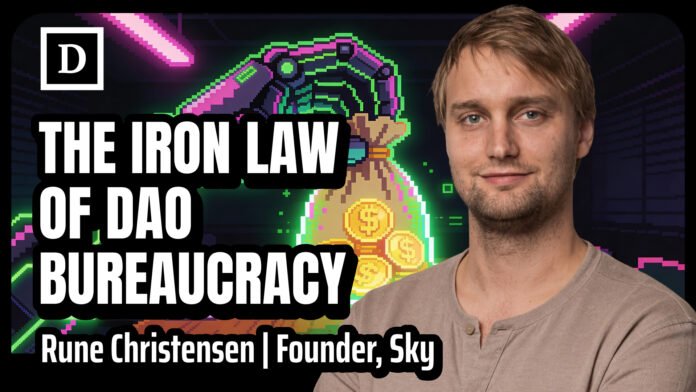
Why DAO Governance Almost Always Turns Political – Insights from Rune Christensen
June 2026 – The DeFi Chronicle
In a recent interview, Rune Christensen, co‑founder of MakerDAO and a long‑time architect of decentralized autonomous organizations (DAOs), argued that politics is an intrinsic by‑product of any decentralized governance system. Drawing on his experience steering Maker through multiple “black‑swans” and on the recent redesign of the Sky protocol, Christensen explained how resource competition, the “iron law of bureaucracy,” and scaling pressures inevitably push DAO participants into political maneuvering.
The inevitable politicisation of DAO governance
| Aspect | What Christensen highlighted | Why it matters |
|---|---|---|
| Resource competition | DAO members constantly vie for limited capital, voting power, and influence over protocol parameters. | When budgets, liquidity incentives, or governance tokens are scarce, factions emerge to protect or expand their share, turning technical decisions into bargaining chips. |
| Iron law of bureaucracy | As a DAO grows, procedural layers (working groups, advisory councils, formal voting cycles) solidify and become self‑preserving. | The very mechanisms meant to make governance transparent and inclusive can ossify, creating an “administrative class” that safeguards its own relevance. |
| Scaling pressure | Larger ecosystems demand faster decision‑making, yet the on‑chain voting cadence remains relatively slow. | The tension between speed and inclusivity forces stakeholders to form coalitions that can “push” proposals through, amplifying political behavior. |
| Identity and narrative | Participants build reputations around specific visions (e.g., “risk‑averse” vs. “growth‑oriented”). | Reputation capital becomes a currency in itself, encouraging lobbying, narrative framing, and, at times, public spats. |
Christensen summed the dynamic up as follows: “In a decentralized governance system, it’s unavoidable to develop politics. The moment you have a shared scarce resource and a set of rules, you get competing interests trying to shape the outcome.” While the quote is paraphrased, the sentiment mirrors his longstanding view that “politics is the glue that holds a DAO together, even if we’d rather it be invisible.”
Sky’s architectural overhaul: a case study
The Sky protocol—a cross‑chain liquidity aggregator that recently migrated from a classic token‑holder voting model to a “dual‑layer” governance framework—offers a concrete illustration of how DAOs attempt to mitigate the political drift.
-
Separation of strategic and operational voting
- Strategic Layer: A small council of vetted experts (the “Strategic Council”) decides long‑term roadmap items, risk parameters, and treasury allocations.
- Operational Layer: The broader token‑holder community votes on day‑to‑day parameter tweaks, fee adjustments, and incentive schedules.
-
Dynamic quorum thresholds
- Quorum requirements automatically adjust based on the proposal’s impact score, ensuring high‑risk changes demand broader consensus while low‑impact tweaks can move faster.
- Incentivised participation pools
- Users who actively vote in the operational layer receive “participation credits” that can be staked for additional governance weight in the strategic layer, encouraging cross‑layer engagement.
Christensen praised Sky’s design as “a pragmatic response to the iron law of bureaucracy.” By formally recognising two distinct decision‑making circles, Sky hopes to keep the “bureaucratic core” accountable without stifling broad community input.
Analyst commentary
- Governance scholar Dr. Elena Morales notes that the politicisation Christensen describes is not a flaw but an emergent property of commons‑based systems. “When you align incentives around a shared token, you also create a political economy. The challenge is to design institutions that channel that energy productively.”
- DeFi venture firm Hexa Capital observes that DAOs that embrace explicit political structures—such as elected councils, term limits, or delegated voting—tend to weather market volatility better than those that cling to pure token‑majority models.
Key takeaways
- Politics is unavoidable: Scarcity, reputation, and procedural complexity naturally breed political behavior in any DAO.
- Bureaucracy solidifies over time: The “iron law of bureaucracy” predicts that governance structures will evolve to protect their own existence, risking ossification.
- Layered governance can help: Splitting strategic and operational decisions, as Sky demonstrates, can balance inclusivity with efficiency.
- Dynamic quorums mitigate capture: Adjusting voting thresholds based on proposal impact reduces the incentive for minority coalitions to block high‑value upgrades.
- Incentivising broad participation remains crucial: Reward mechanisms that encourage token‑holders to vote across layers keep the community engaged and dilute the power of entrenched elites.
Looking ahead
Christensen’s reflections reinforce a growing consensus among DAO architects: rather than fighting political dynamics, the next wave of protocol design will aim to institutionalise them. Expect more multi‑layer governance models, term‑based council elections, and algorithmic quorum mechanisms to appear in upcoming DAO upgrades.
For investors and developers, understanding the political undercurrents of DAO governance is no longer optional—it’s a prerequisite for navigating the rapidly maturing decentralized finance landscape.
Source: https://thedefiant.io/podcasts-and-videos/podcast/why-dao-governance-always-turns-political-