Introducing “Owner Labels”: A New Dataset to Reveal Who’s Behind Blockchain Transactions
Dune Analytics launches a public‑beta data set that tags blockchain addresses with information about the organizations that control them, promising deeper insight for analysts, investors and developers.
A first‑look at the dataset
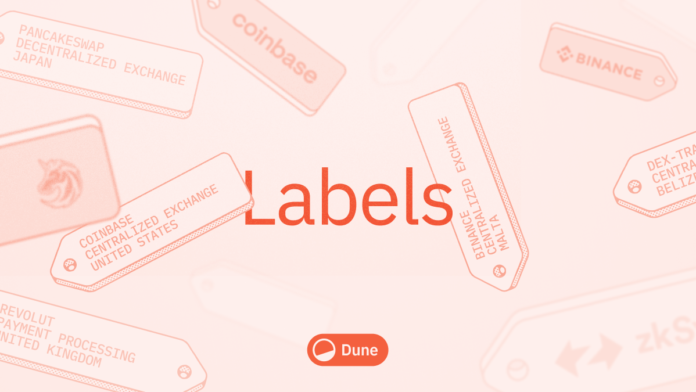
Dune Analytics announced today the rollout of Owner Labels, a curated collection that links on‑chain addresses to the companies, foundations or projects that own them. Unlike existing address‑tagging services that often focus on individual wallets, Owner Labels are deliberately limited to institutional entities, preserving the anonymity of private holders.
Each entry in the set supplies a handful of key attributes:
- Category – the industry or functional segment (e.g., exchange, DeFi protocol, NFT marketplace).
- Headquarters country – geographic location of the organization.
- Online presence – official website, Github repository and, where applicable, documentation links.
The data is published across several tables in Dune’s schema:
| Table | Content |
|---|---|
labels.owner_details |
Directory of labeled owners with their metadata. |
labels.owner_addresses |
Mapping of owners to the blockchain addresses they control. |
labels.transfer_summary |
Token‑transfer aggregates for labeled addresses. |
labels.transfer_summary_daily |
Daily token‑transfer volume for the same set. |
labels.counterparty_activity_daily |
Flow of tokens between an owner and its counterparties over time. |
At launch the labels cover more than 50 % of the on‑chain value for ETH and roughly 25 % of the value across all supported assets. Dune projects that coverage will climb to 50 % for the broader asset universe in the coming months.
Why the “who” matters
Blockchain analytics has traditionally excelled at tracking the “what” – token movements, contract calls, gas consumption – but the lack of reliable entity information has hampered higher‑level analysis. Owner Labels aim to close that gap by:
- Competitive benchmarking – firms can compare inflows and outflows against peers, spotting shifts in market share.
- Macro‑level market analysis – analysts can surface trends within categories such as “stablecoin issuers” or “Layer‑2 solutions”.
- Business intelligence – project teams gain a clearer picture of the institutions interacting with their protocols, supporting partnership and go‑to‑market strategies.
In a sector where regulatory scrutiny is tightening, having a transparent, standardized view of institutional participants also simplifies compliance reporting and anti‑money‑laundering (AML) checks.
Development approach and community involvement
The dataset was shaped by a working group of 15 industry experts, drawing on best‑practice guidelines from the Open Labels Initiative to ensure interoperability with other tagging frameworks. Automated quality controls and AI‑driven verification processes were built into the pipeline to maintain accuracy as new addresses are added.
Sergi Juanati, Head of Analytics at Steakhouse Financial, highlighted the collaborative advantage:
“A unified labeling framework eliminates duplicated effort and inconsistent data, making it easier for the whole ecosystem to stay aligned and up‑to‑date.”
Dune is positioning itself as the primary provider of these labels, leveraging its existing analytics infrastructure, public audit logs, and an invitation‑only expert community to keep the dataset current.
How to get involved
Dune is open to contributions from professionals who spot missing entities or wish to suggest refinements. Interested parties can request access to the invite‑only expert group or submit feedback directly to [email protected].
Analyst perspective
The introduction of Owner Labels represents a significant step forward for on‑chain intelligence. By coupling address activity with corporate identity, analysts can move beyond pure transaction graphs and begin to ask strategic questions such as:
- Which institutions are accelerating adoption of a new protocol?
- How do regulatory events (e.g., a jurisdiction’s crypto ban) reflect in the behavior of local firms?
- What concentration risks exist when a handful of entities dominate liquidity provision in a given market?
Early adopters may gain a competitive edge by integrating these labels into risk models, portfolio dashboards, or market‑sentiment tools.
Key takeaways
- Owner Labels provide a structured map of institutional owners behind blockchain addresses, including category, country and web presence.
- The beta launch already maps >50 % of ETH value and ~25 % across all assets, with plans to reach 50 % coverage for the whole ecosystem.
- Data is available through Dune’s public tables, facilitating immediate integration into existing analytics pipelines.
- The project follows open‑label standards, employs automated quality checks, and is backed by a panel of 15 industry experts.
- Community contributions are encouraged via a dedicated email channel, aiming to keep the dataset comprehensive and up‑to‑date.
As the crypto landscape matures, tools that illuminate who is moving what will become indispensable. Owner Labels may soon be a baseline component of any serious DeFi or blockchain research workflow.
Source: https://dune.com/blog/introducing-owner-labels-what-they-are-and-why-they-matter