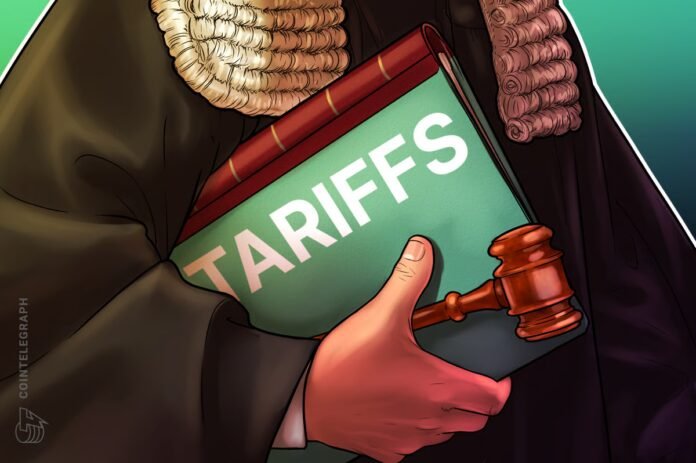
Supreme Court Declares Trump‑Era Tariffs Unconstitutional Under IEEPA
Washington, D.C., Feb. 20 2026 — In a 6‑3 decision, the United States Supreme Court ruled that former President Donald Trump’s sweeping tariff regime could not be imposed under the International Emergency Economic Powers Act (IEEPA). The opinion, released on Friday, held that the statute does not grant the President authority to levy tariffs in peacetime, marking the first time the Court has directly addressed the intersection of emergency powers and trade policy.
The Court’s Reasoning
Justice [Name] wrote for the majority, emphasizing that IEEPA was never intended as a tool for broad tariff imposition. The opinion noted:
- “IEEPA does not authorize the President to impose tariffs,” and that the executive branch lacks any “inherent authority” to do so absent a declaration of war or a comparable national emergency.
- Over the past fifty years, no president has invoked IEEPA to enact tariffs of the magnitude proposed by the Trump administration. The lack of historical precedent, combined with the expansive scope of the tariffs, pushed the action beyond the President’s “legitimate reach.”
The majority concluded that Trump’s assertion that drug inflows from Canada, China, and Mexico, together with perceived deterioration of the U.S. industrial base, constituted an IEEPA‑eligible emergency was unsupported by the law’s text or purpose.
Trump’s Reaction
In a press briefing shortly after the decision, Trump condemned the justices who voted against his tariff plan, describing the ruling as “deeply disappointing” and accusing the Court of lacking courage. He signaled that he would pursue “other alternatives” to reinstate the tariffs, although no concrete legislative path has been outlined.
Background: Tariffs and the Crypto Market
The tariffs announced by Trump in 2025—most notably the 100 % duty on Chinese imports announced in October—triggered volatile swings across global equity and cryptocurrency markets. Bitcoin’s price plunged from roughly $122,000 to $107,000 within minutes, and the broader crypto sector experienced a sharp sell‑off driven by leveraged positions and heightened uncertainty. Although the market later stabilized, Bitcoin remains roughly 50 % below its October peak, and analysts attribute part of the lingering weakness to lingering policy uncertainty.
What the Ruling Means for Crypto and Trade Policy
- Legal Clarity on IEEPA – The decision draws a firm line about the limits of executive emergency powers, reducing the likelihood that future administrations will attempt to use IEEPA for large‑scale tariff schemes. This should diminish the risk of abrupt trade‑related market shocks.
- Policy Predictability – With the Supreme Court’s guidance, congressionally‑authorized trade measures will likely be the primary avenue for any future tariff initiatives, offering greater transparency for investors.
- Crypto Market Resilience – While the ruling does not directly alter crypto regulations, the removal of a major source of macro‑economic volatility may help stabilize demand for digital assets, especially those that have been marketed as hedges against geopolitical risk.
- Potential Legislative Action – Should Trump or other policymakers pursue tariff reinstatement, they will need to secure congressional approval. The political calculus of such a move could revive market turbulence, particularly if the measures target major trading partners.
Key Takeaways
| Point | Impact |
|---|---|
| Supreme Court majority (6‑3) invalidates Trump tariffs under IEEPA | Confirms that the statute cannot be used to impose peacetime tariffs. |
| Historical precedent | No president has previously used IEEPA for tariffs, underscoring the Court’s concern about overreach. |
| Trump’s response | Vows to seek alternative mechanisms, but no concrete plan has emerged. |
| Crypto market relevance | Past tariff announcements caused sharp price drops; the ruling may reduce future abrupt market moves. |
| Future pathway | Any new tariff regime would require congressional legislation, increasing policy predictability for investors. |
The decision, accessible through the Supreme Court’s opinion docket (2025‑1287), represents a pivotal moment in the ongoing debate over executive authority, trade protectionism, and their ripple effects across financial markets, including the burgeoning cryptocurrency sector.
Cointelegraph adheres to its editorial policy of independent, transparent journalism. Readers are encouraged to verify information independently.
Source: https://cointelegraph.com/news/scotus-strikes-trump-tariffs-alternative-plan?utm_source=rss_feed&utm_medium=feed&utm_campaign=rss_partner_inbound