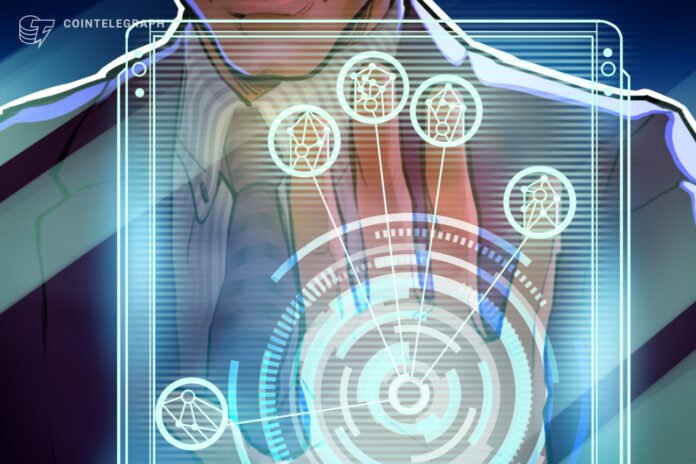
VeryAI Secures $10 Million Seed Round to Deploy Palm‑Scan Identity Verification on Solana
March 12 2026
Crypto‑focused startups are racing to build “proof‑of‑human” tools as AI‑generated accounts threaten the integrity of online platforms. VeryAI, a biometric‑authenticity company, announced a $10 million seed financing led by Polychain Capital, with participation from the Berggruen Institute, Anagram, and Solana co‑founder Anatoly Yakovenko as an angel investor. The capital will fund the rollout of a palm‑scan based identity system that records attestations on the Solana blockchain.
What VeryAI Is Building
VeryAI’s platform captures an image of a user’s palm using a standard smartphone camera. The image is processed locally into a cryptographic “biometric signature” – a one‑way representation that cannot be reverse‑engineered into the original palm. This signature is then stored on Solana as an immutable proof that the holder is a unique, living person, while the raw biometric data never leaves the device.
Key technical features include:
- Zero‑knowledge proofs (ZKPs): Users can demonstrate ownership of a valid palm signature without revealing any personal identifiers, allowing cross‑platform verification while preserving privacy.
- Irreversible feature extraction: The system converts the scan into a hash‑like vector, eliminating the possibility of reconstructing the original palm image.
- Solana integration: Leveraging Solana’s high throughput and low transaction fees, VeryAI can issue identity attestations at scale, suitable for high‑velocity crypto exchanges and fintech services.
Market Context
The need for robust human verification has sharpened as generative AI tools enable the mass production of synthetic identities, deepfakes, and bot‑driven Sybil attacks. Crypto exchanges, token‑incentivised platforms, and decentralized finance (DeFi) services are increasingly vulnerable to:
- Fake‑account farming that harvests token rewards,
- Impersonation scams targeting community members, and
- Regulatory pressure to implement stronger “Know‑Your‑Customer” (KYC) safeguards.
Industry observers, including Andreessen Horowitz’s Chris Dixon, have warned that an “ocean of AI‑powered deepfakes and bots” could erode trust across the internet, and that blockchain‑anchored identity solutions may be a viable countermeasure.
VeryAI joins a nascent cohort of biometric ID projects. Worldcoin, for example, uses iris and facial scans to generate a “World ID” recorded on a blockchain, but it has attracted criticism from privacy advocates over the invasiveness of its hardware orbs. By opting for palm biometrics—an area less exposed in everyday surveillance—and by employing ZKPs, VeryAI positions itself as a more privacy‑conscious alternative.
Partnerships and Early Adoption
The startup has already begun integrating its solution with a handful of crypto‑focused firms, including:
- MEXC – a major spot and derivatives exchange,
- Colosseum, Clique, and Talus – platforms that manage token‑based gaming and community incentives.
Additional centralized exchanges and wallet providers have reportedly expressed interest in piloting the technology ahead of a broader public launch later this year.
Investor Perspective
Polychain Capital’s lead investment underscores the firm’s continued belief in identity‑layer infrastructure as a core component of the Web3 stack. Anatoly Yakovenko’s participation adds a strategic dimension, given his deep involvement in Solana’s ecosystem and his advocacy for scalable, low‑cost on‑chain solutions.
“The internet can no longer assume that every post, transaction, or interaction originates from a real person,” said Zach Meltzer, VeryAI’s founder and CEO, in an interview with Cointelegraph. “Our goal isn’t just to prove a human exists somewhere—it’s to give platforms a reliable way to confirm that a genuine individual is taking action.”
Analysis
-
Technical Viability: Palm biometrics are less commonly used than facial or iris scans, reducing the risk of mass data leakage from existing surveillance databases. However, the reliability of smartphone‑captured palm images under varied lighting conditions will be a critical performance metric.
-
Regulatory Fit: Zero‑knowledge proof‑based attestations could satisfy emerging regulatory frameworks that demand “privacy‑by‑design” KYC, potentially easing compliance burdens for exchanges operating across multiple jurisdictions.
-
Competitive Landscape: While Worldcoin and similar projects have garnered significant attention, their reliance on specialized hardware and facial data may limit adoption among privacy‑sensitive users. VeryAI’s software‑only approach could lower entry barriers, though it must still convince users to trust a new biometric modality.
-
Network Effect: Embedding identity proofs on Solana creates a public, tamper‑proof ledger of human verification, which could be leveraged by any downstream dApp. The more platforms adopt the standard, the more valuable each individual attestation becomes—a classic network‑effect scenario.
- Potential Risks: The primary challenges include user onboarding friction (capturing a clean palm image), potential spoofing attacks using high‑resolution prints, and broader public skepticism toward biometric data collection, even when the raw data is never stored.
Key Takeaways
- Funding: VeryAI raised $10 million, led by Polychain Capital, with strategic investors including the Berggruen Institute, Anagram, and Solana co‑founder Anatoly Yakovenko.
- Product: A palm‑scan based, zero‑knowledge proof identity system that records immutable human attestations on Solana.
- Use Cases: Designed for crypto exchanges, fintech firms, and online platforms that need to combat bots, deepfakes, and synthetic identities.
- Early Traction: Partnerships already in place with MEXC and several gaming‑oriented platforms; additional exchanges are evaluating integration.
- Industry Impact: The solution could become a cornerstone of “proof‑of‑human” infrastructure, complementing other biometric projects while offering a more privacy‑respectful alternative.
As AI‑driven impersonation tactics become more sophisticated, the crypto sector’s appetite for trustworthy, privacy‑preserving identity verification is likely to grow. VeryAI’s palm‑scan approach, backed by a notable seed round and Solana’s high‑speed network, may well position it as a key player in the emerging proof‑of‑human ecosystem.
The information in this article is based on publicly released statements from VeryAI and its investors. Readers are encouraged to verify details independently.
Source: https://cointelegraph.com/news/polychain-backs-veryai-s-10m-raise-to-build-palm-scan-identity-system-on-solana?utm_source=rss_feed&utm_medium=feed&utm_campaign=rss_partner_inbound